There are three watches sitting in a case at a boutique right now, each with a word on the dial or the box that a shopper reads as one claim: chronometer. One of them was tested as a bare, uncased movement, against a single published number, by an organisation that certified just over two million other movements the same way last year. Another was tested — possibly — by the brand that made it, in the brand’s own laboratory, against one of three different numbers depending on how big the movement is, with a government institute checking the paperwork rather than running the stopwatch. The third carries a number tighter than either of the first two, set entirely by the brand, checked by nobody outside the building.
All three are honest uses of the word. None of them are the same test, and the differences are exactly the kind that get flattened in a showroom sentence — “COSC certified,” “Master Chronometer,” “our own exacting standard” — into a single implied claim of precision. They are not implying the same thing, because they are not testing the same thing, in the same place, to the same number. This is a guide to what each one actually is, read from the standards themselves rather than from the marketing built on top of them.
COSC: one number, and it is not testing your watch
The Contrôle Officiel Suisse des Chronomètres is the oldest and plainest of the three. It runs three official test bureaux — Biel/Bienne, Le Locle and Saint-Imier — descended from cantonal observatory testing and now organised as an association whose governing board includes delegates from the founding cantons, from METAS, and from the industry itself. In 2025 it took delivery of 2,238,671 movements and issued 2,071,707 chronometer certificates, a failure rate of 4.7%, identical to 2024’s. More than 60 brands submit to it.
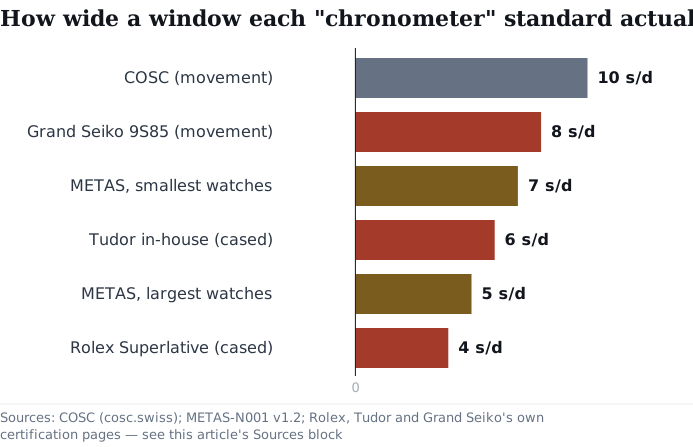
What COSC certifies is the movement, uncased. Its own deposit specifications require mechanical movements to be “deposited unarmed” — stripped, without the case, dial or hands that will eventually surround them — and tested exactly as removed from the production line. The test follows ISO 3159, a standard COSC’s own 2025 annual report notes has governed wrist chronometers “since 1976”: fifteen days, five positions (crown up, crown left, crown right, dial up, dial down), three temperatures (8°C, 23°C and 38°C), seven measured criteria. The headline one, average daily rate, has a published tolerance of -4 to +6 seconds a day. The other six — mean variation in rate, greatest variation, the difference between horizontal and vertical positions, the largest single deviation, rate change against temperature, and how cleanly the rate resumes after a shock — are all narrower checks on the same idea: not just how far the watch drifts, but how consistently it drifts.
Two structural points rarely make it into the retelling. First, COSC certification is closed to anyone without a trademark registered in Switzerland and a watch that meets the Swiss Made ordinance — a brand that cannot clear “Swiss made” cannot clear COSC either, whatever its movement actually does on the timing machine. Second, although COSC’s own general conditions split submissions into two categories by movement diameter (over 20mm and 20mm or under) for its own record-keeping, the tolerance it publishes to the public — that -4/+6 figure, repeated on both its FAQ and its certified-chronometer page — is quoted as a single number, not a graduated one. Whether the underlying ISO 3159 text varies that number by movement size the way METAS’s does is not something this piece can check: ISO sells the standard itself, and COSC’s own public-facing pages state only the one figure.
METAS: three numbers, and a test the brand can run itself
Grand-scale certification, and there is confusion about it that starts with the sentence used to describe it. Omega, needing a mark of quality above COSC for its post-2013 movements, worked with the Federal Institute of Metrology (METAS) — Switzerland’s national metrology body, the one that also calibrates the country’s speed cameras and fuel pumps — to build a second-stage certification. It launched in 2015, with the Globemaster the first watch to carry it, and both Omega’s own account and the certifying standard agree on the prerequisite: a watch cannot even be submitted for Master Chronometer testing unless its movement has already passed COSC.
Master Chronometer testing covers ground COSC does not touch at all. It is run on the fully cased watch, not the bare movement. It exposes the watch twice to a magnetic field of 1.5 tesla — 15,000 gauss, roughly the field inside an MRI scanner — once on the naked movement and once on the finished case, and the watch must keep running through both. It checks that the declared power reserve actually holds. It puts the watch through a water-overpressure test to the pressure the brand claims. And its precision test, unlike COSC’s, is run across two temperatures and two states of wind — fully wound, and at a third of the declared reserve — specifically so a watch that runs fast when full and slow when nearly empty cannot average its way to a pass.
Here is the number almost nobody prints correctly. METAS-N001, the actual requirements document, sets the average daily rate tolerance by movement size, in three tiers: 0 to +5 seconds a day for the largest watches (fitting diameter over 26mm), 0 to +6 for the middle band (20–26mm), and 0 to +7 for the smallest (20mm or under). “0/+5” is the number that gets quoted — by trade coverage, and by brand pages, Tudor’s own certification page among them — as if it were the whole standard. It is one-third of it, and it is the tightest third.
The bigger structural fact sits in the standard’s own definitions section, and it changes what “METAS certified” actually promises. METAS-N001 defines the “testing laboratory” — the entity that performs the ten prescribed test cycles — as an entity that “can be the applicant’s in-house laboratory or the laboratory of a third-party entity commissioned by the applicant.” In practice, this generally means Omega and Tudor test their own watches, in their own facilities. METAS’s job, on paper, is not to run that stopwatch. It is to monitor the laboratory that does: statistical analysis of every result the lab reports, periodic sample checks against an ISO 2859-1 sampling plan, and a quality-system audit at least once a year, with the power to demand extra measurements or a full audit if something looks wrong. That is real oversight — closer to a financial auditor checking a company’s own books against a sampling standard than to a factory inspector standing at the bench. It is not, however, what the phrase “METAS certified” implies to most people reading it off a case back.
The in-house layer: sometimes tighter, sometimes just a name
Above both of those sits a tier of standards that answer to nobody but the brand that wrote them, and they are not interchangeable either.
Rolex’s is the most transparent of the three examined here, because it is stacked rather than standalone. Every Rolex movement is still COSC-certified first. Rolex then re-tests the cased, finished watch a second time, in its own laboratories, on equipment it built for the purpose, to a -2/+2 seconds a day tolerance — roughly a fifth the width of the COSC window it replaces. In 2026, Rolex added three further criteria to that in-house pass — resistance to magnetism, reliability, and sustainability, checked during design and manufacturing rather than only at the final bench — on top of the precision, waterproofness, self-winding and power-reserve checks set when the certification was last redefined in 2015.
Tudor’s is a third layer stacked on top of the other two, and it is the clearest illustration of how these regimes actually nest. A Manufacture Calibre Tudor is first COSC-certified, then METAS-certified, then held by Tudor’s own final standard to -2/+4 seconds a day — a full two seconds tighter than the -4/+6 COSC floor it started from, one second tighter than the 0/+5 METAS ceiling for its size class, but two seconds looser than Rolex’s own -2/+2. Three certifications, three different numbers, on watches from companies under the same roof.
Grand Seiko sits outside both systems entirely — no COSC, no METAS, nothing bearing a Swiss institute’s name, because Grand Seiko is not chasing “Swiss made” in the first place. Its own published spec for calibre 9S85 is a mean daily rate of +5 to -3 seconds measured on the bare movement, before casing, across six positions over twelve days — fewer positions than COSC’s five-position, fifteen-day regime might suggest, but a tighter number, checked nowhere but Shiojiri. Grand Seiko separately quotes an +8/-1 seconds a day figure for “normal usage” — the cased, worn, real-world guarantee, which is a looser number than the lab spec, exactly as the METAS distinction between wound and part-wound rates would predict.
Not every in-house standard is this legible. The pattern worth watching for, as a reader rather than an engineer, is simple: a brand that publishes the actual tolerance, the actual test conditions and the actual position count — as Rolex, Tudor and Grand Seiko all do — is telling you something checkable. A brand that only publishes the seal and the phrase “exacting internal standards” is not, and there is no way to know from the outside whether that phrase means a movement regulated to a tenth of a second or a COSC-certified movement with a new sticker on the box.
Laid out as widths rather than described in prose, the spread is the whole argument:
What none of them measure
Every one of these regimes, without exception, is a laboratory simulation: a machine rotating the watch through fixed positions on a schedule, not a watch worn on an actual wrist through an actual week of getting in and out of pockets, gym bags and winter coats. None of them test what happens after five years and a service, only what a watch does new. And COSC’s 4.7% failure rate is itself a useful corrective to the idea that any of this is theatre — on 2.2 million movements a year, that is roughly 105,000 rejections, a real bar that a real number of movements fail to clear.
Our read, from the bench rather than from any of these documents: a well-regulated movement from an independent watchmaker, adjusted by hand with modern lubricants and a CNC-cut escapement, can beat every number on the chart above without carrying a single one of these certifications, because none of them are measuring the ceiling of what a mechanical watch can do — they are measuring the floor every unit sold under a given name is guaranteed to clear. That is the entire point of a production certification and the reason it is not the same claim as “well regulated.” A hand-finished piece can be extraordinary and unrepeatable. A certification is a promise that the ten-thousandth watch off the line performs the same as the first — which is a smaller claim than “precise,” and, at scale, a harder one to keep.
The short version
If a watch says “COSC,” you know one number, checked on the bare movement, by an outside body, against a public standard. If it says “Master Chronometer,” you know three possible numbers depending on the watch’s size, checked on the finished watch, largely by the brand itself, under a government institute’s statistical audit rather than its own stopwatch. If it says only “our own exacting standard,” you know nothing until the brand tells you the actual figure — and the brands that are proud of that figure tend to print it.