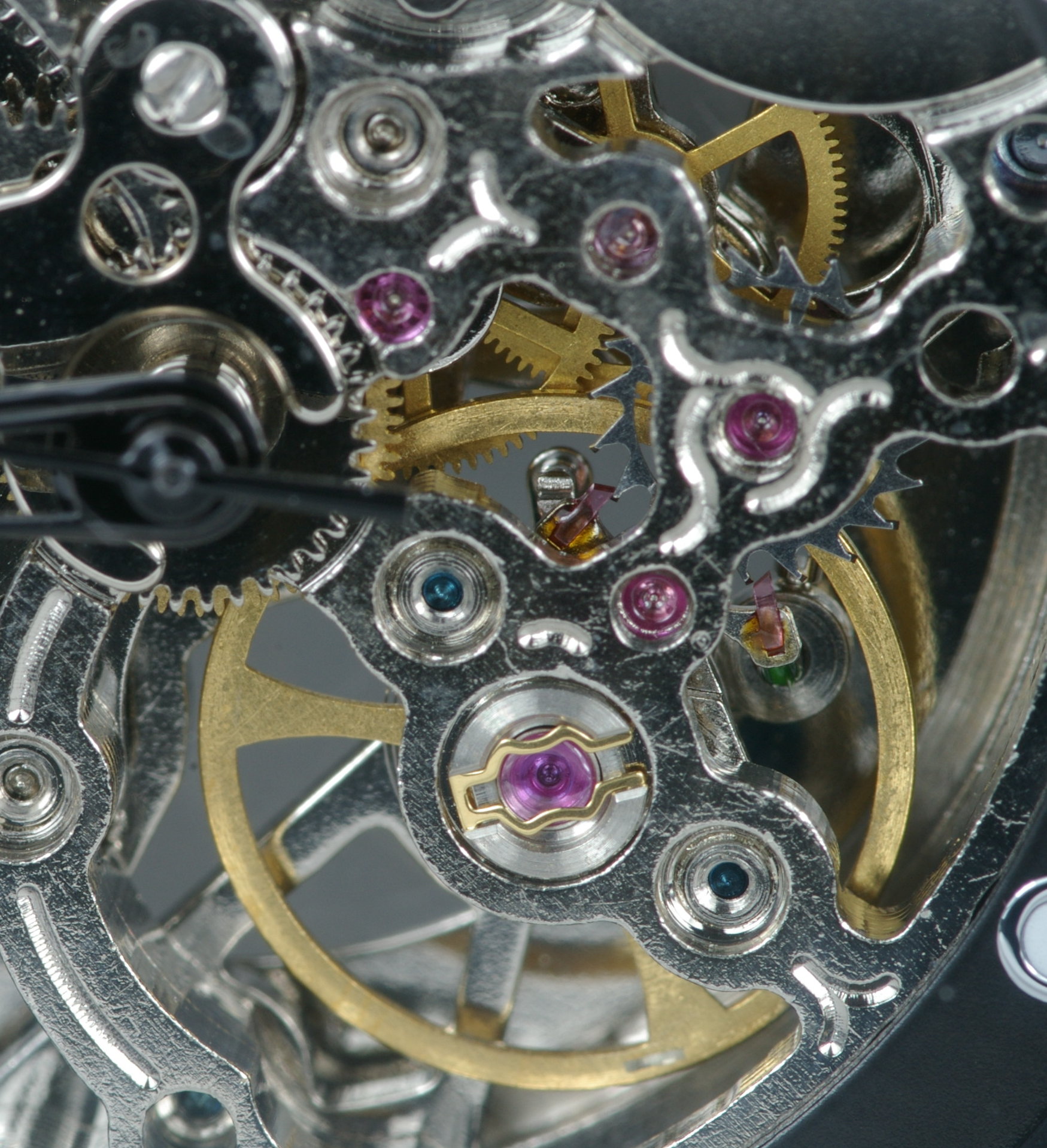
Somewhere right now, a collector is showing off a six-figure wristwatch, and an onlooker is quietly concluding it must be a fake — because the seconds hand ticks. One step per second, like a $12 quartz from a petrol station.
That tick is called deadbeat seconds, and it is the most misunderstood display in watchmaking. What follows is what it actually is, where it comes from, why Rolex abandoned it, and why some of the most serious watchmakers alive resurrected it.
What it actually is
A conventional mechanical watch ticks fast. The balance oscillates several times a second — 4Hz in most modern movements, eight beats per second — so the seconds hand advances in a rapid stutter that reads as a smooth sweep. That sweep is how most people have been taught to spot “a real watch.”
A deadbeat seconds watch takes all that high-frequency effort and deliberately disciplines it into one clean jump per second. The hand snaps forward, stops dead — hence the name — and waits. Sixty jumps per minute. Underneath, the movement is oscillating as fast as ever; a dedicated mechanism gathers those beats and releases the seconds hand exactly once a second.
The engineering problem is the stopping, not the jumping. A hand that halts and restarts sixty times a minute, without disturbing the timekeeping of the very oscillator driving it, requires either a second gear train, a captive escapement, or a small energy-storing device called a remontoire feeding the display in metered doses. None of these is simple. All of them exist purely to make the watch look like it isn’t trying.
Where it comes from: the observatory, not the boutique
Deadbeat seconds predates the wristwatch by about two and a half centuries, and it was never a party trick. In 1675 Richard Towneley devised the deadbeat escapement for the regulator clocks of the new Royal Observatory at Greenwich; George Graham later refined and popularised it. In a precision pendulum clock, eliminating recoil — the slight backward kick of the escape wheel — was worth real accuracy, and a seconds hand that stepped once per second let an astronomer count time by eye and ear while watching the sky. The tick wasn’t the compromise. The tick was the point.
The logic carried into the mid-20th century. In the 1950s — an era of synchronised clocks, scientific timekeeping, and professionals who needed to measure to the second — a seconds hand that moved in exact one-second steps was a working tool. A doctor taking a pulse could count against it. This is the context in which the complication reached the wrist.
The watch that proved the problem: Rolex Tru-Beat
In 1954 Rolex released the Tru-Beat, reference 6556: a deadbeat seconds wristwatch driven by a secondary escapement, aimed — the standard telling goes — at doctors who wanted that countable tick. It lasted about five years in the catalogue, and it remains the only deadbeat seconds wristwatch Rolex has ever put into production.
The Tru-Beat failed commercially for the most DEAD BEAT reason imaginable: the market was busy learning that ticking meant cheap. Within two decades quartz arrived and made the one-tick-per-second hand the universal signature of a disposable watch. The complication’s honest, scientific virtue became indistinguishable from the thing killing the Swiss industry. Watchmakers quietly dropped it.
There is a period postscript that tells you everything about how unloved the mechanism was: vintage dealers report that many Tru-Beats had their deadbeat mechanism removed by watchmakers during servicing over the decades, because it was troublesome to maintain and owners didn’t miss it. A complication so misunderstood that it was amputated as a favour. Surviving unmolested examples now trade as rarities.
The revival: precision as a flex
The modern return of deadbeat seconds is a post-quartz phenomenon, and its meaning has inverted. Once quartz won the accuracy war, mechanical watchmaking’s only remaining argument was difficulty for its own sake — and few things are more difficult, or more deliciously perverse, than spending years of engineering to make a mechanical watch tick like the quartz watch it refuses to be.
The watches that matter, roughly in the order the modern arc unfolded:
- Habring² Erwin (Austria). The affordability champion — widely cited as the most attainable serious deadbeat seconds watch in production, from the husband-and-wife operation that also builds the Jumping Second Pilot. Proof the complication doesn’t require a six-figure price to be done honestly.
- Grönefeld One Hertz (Netherlands, 2010). The independent-watchmaking landmark: the Grönefeld brothers drove the deadbeat seconds from its own dedicated gear train — a twin-train architecture that made the complication the star of the watch rather than a parlour trick bolted onto a base movement.
- Arnold & Son DSTB (2014). Put the entire true-beat mechanism on the dial side, so the owner can watch the anchor work — the complication as theatre, which is at least honest about why anyone buys complications.
- Jaeger-LeCoultre Geophysic True Second (2015). The complication’s return to a major maison’s core collection, tied to JLC’s own 1950s Geophysic chronometer heritage — the “scientific instrument” framing, revived as brand storytelling.
- A. Lange & Söhne Richard Lange Jumping Seconds (2016). The German-school maximalist answer: deadbeat seconds executed via a one-second remontoire feeding constant force to the display, in the Richard Lange scientific-watch line. Peak difficulty-as-luxury.
- Jaquet Droz Grande Seconde Deadbeat (2017), Garrick S2 (UK), and others round out the field — the complication now spans from Austrian value proposition to English bespoke.
Each of these makers chose a different architecture — captive escapement, independent train, remontoire, star-and-flirt release — because there is no standard way to build one. That’s part of the appeal: deadbeat seconds is one of the few complications where the engineering is still an open argument.
Why we named a publication after it
Deadbeat seconds is the complication as metaphor, and we’ll own it plainly.
It is precision that reads as cheapness to anyone judging by surface. It is a mechanism doing enormous hidden work to produce an output everyone thinks they already understand. It is a 350-year-old scientific tool that the industry abandoned out of image anxiety and then resurrected as a luxury flex once the anxiety became profitable. There is no better mascot for a publication that intends to time the watch industry — tick by tick, on its own precise terms — without caring much whether the output looks fashionable.
The industry runs on sweep: smooth, continuous, reassuring motion that discourages you from counting. We prefer the tick. It’s countable. That’s the point.