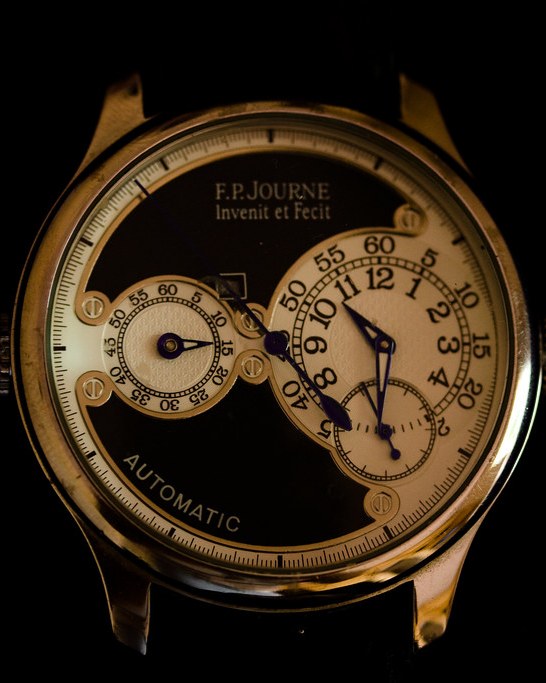
This spring at Phillips in Geneva, an F.P. Journe Chronomètre à Résonance “Souscription” No. 007 sold for $13.92 million — the most ever paid at commercial auction for a watch by an independent watchmaker, and for any watch made in this century. Four more Journes cleared between $1.9 million and $5 million in the same season. By the market’s arithmetic, François-Paul Journe is now the most valuable living watchmaker, and it isn’t close.
Notice, though, which watches set the records. Not this year’s production. The souscription pieces — the tiny run of watches Journe sold by subscription to fund his company’s birth around 1999, from a workshop that barely existed yet. The money is not chasing the brand. It is chasing the earliest, scarcest, most personal work of one man’s hands — the part of the story that is already finished and can never be added to.
That is the succession problem, priced in dollars. And it deserves to be examined plainly, because F.P. Journe is the standard-bearer for all of independent watchmaking: how this question resolves here will shape how collectors, and capital, treat every independent that follows.
What was actually built
Credit first, because it’s the foundation of the whole question. Journe — born in Marseille in 1957, trained in Paris, a restorer of historical pieces before he was a maker of new ones — did not build an atelier. He built a manufacture: movements, dials and cases made in-house in Geneva, movements famously executed in rose gold, output in the high hundreds of watches per year against demand that would absorb multiples of that. Chronometry as the organising obsession — Invenit et Fecit on every dial as both boast and receipt — with genuine inventions (the modern résonance wristwatch above all) rather than repackaged complications.
In other words: alone among the moderns, Journe built something with the industrial depth of a real company and the desirability of a single artist’s signature. That combination is precisely what makes the succession question so sharp. A company can outlive its founder. A signature cannot.
The answer Journe already gave
Here is the part that coverage of the brand routinely omits. In September 2018, when Chanel took a 20% stake in Montres Journe SA, Journe explained the decision himself, on the record — and his explanation was not about capital, distribution, or growth:
“Today, with no certainty that my children will continue my work, I have decided to guarantee the future of my business by choosing to bring in Chanel.”
Read that again. The most important independent watchmaker alive stated publicly, seven years ago, that family succession was uncertain at best, and that his chosen continuity mechanism was equity in the hands of a large, private, patient French luxury house. Chanel, for its part, has spent the years since assembling exactly this portfolio — minority positions across serious watchmaking, F.P. Journe among them.
This was an honest, prudent, even admirable answer. It is also an answer with contents worth spelling out: the future of F.P. Journe, whenever François-Paul steps back, runs through Chanel’s boardroom — a house whose skill is the immortal stewardship of a founder’s brand. Chanel has kept a couture label vital for over half a century after its founder’s death. Whether that model transfers from fashion houses to a watchmaker whose product is chronometric invention is the open question — because nobody has ever done it with a manufacture like this one.
What the precedents say
Watchmaking has run this experiment before, and the results should temper everyone’s confidence:
- Daniel Roth — the closest historical parallel: a revered independent whose name outgrew his ownership. The man lost control of his brand; the name passed through corporate hands for decades before its recent revival — as a heritage property, curated by others.
- George Daniels → Roger Smith — the one succession that worked, and note how: not by equity or estate planning, but by a decade of apprenticeship transferring the actual craft to a named human being who now makes watches under his own name. The succession asset was a person, not a shareholding.
- The majors — Patek Philippe’s family transitions work because the company long ago became an institution whose founders’ hands are not the product. That is precisely the transformation an independent must undergo to survive succession — and precisely the transformation that dilutes what collectors are paying for.
The pattern is uncomfortable but consistent: brands survive founders; signatures don’t. The only clean transfer on record moved the craft into another set of named hands.
What the market is telling you
Which brings us back to the $13.92 million. Auction money is unsentimental, and its behaviour around Journe is a forecast: record prices for souscription and early pieces — the closed, unrepeatable, biographical work — while the brand’s contemporary output, coveted as it is, trades on a different and lower curve. The market is already treating François-Paul’s career the way it treats a completed oeuvre: front-running the scarcity of the part no successor can make more of.
That is not a crisis. Journe the man is, by all public evidence, still fully in harness, and the manufacture has never been stronger. But strategy questions are asked before they’re urgent or they’re not strategy, so here is the watchlist we’ll be keeping, and updating, as the standard-bearer’s second act approaches:
- Does a named technical heir ever emerge? Not a CEO — a watchmaker, publicly identified with the future of the movements. The Daniels–Smith precedent says this is the single strongest continuity signal that exists.
- What does Chanel’s 20% become? Minority stakes in founder-led houses have a way of quietly compounding at transition moments. Watch the percentage.
- How does the brand talk about Invenit et Fecit over time? The Latin means “invented it and made it.” The day that claim shifts from a statement about a man to a statement about an institution, the succession has begun — whether or not anyone announces it.
- What happens to the order books at the first sign of transition? Multi-year waits are loyalty to a person. Their behaviour at the handover will reprice every independent’s order book, not just this one.
Our verdict chip: Established — the strongest business in independent watchmaking, run by its greatest living practitioner, carrying the category’s hardest unanswered question. He answered half of it in 2018. The other half — who makes the watches — is the one the whole independent world will be watching.
This is the first in our series of independent-maker profiles: the same lens, applied one atelier at a time. MB&F, Akrivia and Laurent Ferrier are next.