Rolex changed its prices twice in 2026, which it almost never does. The first list, on 1 January, raised average prices by 6.2% across Germany, Hong Kong, Japan, the UK and the US — a rise Reuters describes as neither global nor specific to gold, though in the US the steepest movements were on gold references, up to 11.2% on yellow gold against 5 to 7.2% on steel. The second, on 1 June, did something narrower and more interesting. Gold went up an average of 5%. Two-tone Rolesor went up about 2.5%. Steel, platinum, titanium and white Rolesor did not move at all.
A price rise sorted by metal invites exactly one explanation, and the trade supplied it immediately: gold has become expensive, and the watches made of it have to follow. The yellow gold Day-Date 36 went from $43,700 to $45,900. The Yacht-Master II ref. 126688 went from $57,800 to $60,700.
The explanation is checkable, because gold is one of the most precisely priced substances on earth. So we checked it.
What the benchmark actually says
The LBMA Gold Price is set twice a day in auctions run by ICE Benchmark Administration, and the LBMA describes it as the global benchmark price for gold delivered in London. The afternoon setting is the one the trade quotes. The LBMA publishes the entire daily series, back to 1968, as a file anyone can download — which is how the numbers below were read rather than reported.
On 2 January 2026, the day Rolex’s new list took effect, gold set at $4,352.95 an ounce.
On 29 January it set at $5,405.00. That is the highest figure in the series. Not the highest of 2026 — the highest there has ever been.
On 1 June, the day the gold-only increase took effect, it set at $4,449.30.
Between the record and the day gold watches got more expensive, the metal had fallen 17.7%. It kept going: the July average was $4,073.92, and the most recent setting in the series, on 7 August, was $4,335.55 — which is 0.4% below where gold started the year.
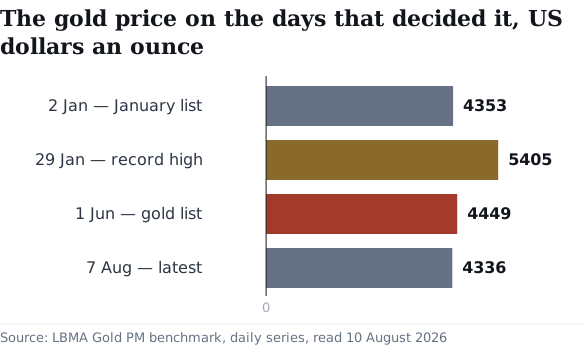
This is not a currency artefact. The LBMA notes that its sterling and euro figures are indicative prices for settlement only, so the dollar benchmark is the one with authority — but the direction survives translation anyway. Between the January and June lists gold rose 2.2% in dollars, 2.6% in sterling and 3.3% in euros. Whichever currency Rolex thinks in, the metal did roughly nothing between its two price lists, having first gone up a great deal and then come most of the way back down.
Four days are four days, though, and choosing them is a way of arguing. So here is every one of them. Both prices are set to 100 on 2 January, the day the first list took effect, which is the only way a metal at four thousand dollars an ounce and a watch at forty-five thousand can be read against each other at all — and it is the honest comparison anyway, because the claim under test is proportional.
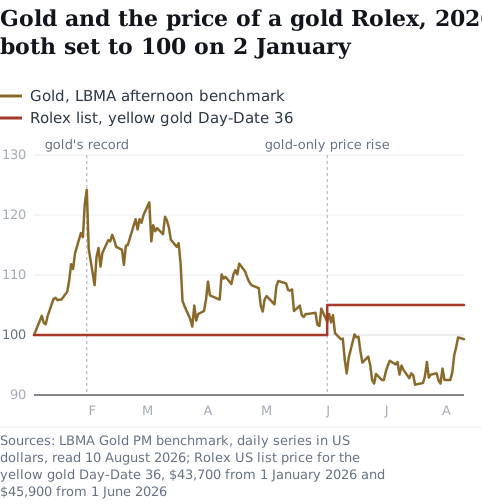
The relationship the trade asserts does not appear. Gold ran up 24.2% by 29 January and spent the following four months giving it back, falling below its own starting level on 8 June — a week after the gold-only increase took effect. It reached its low for the year on 16 July at $3,993.55, 8.3% below where it began. The list moved once in all of that, in one direction. And on every one of the fifty-one settings from the June increase to 10 August, the metal was cheaper relative to January than the watch was.
The sum
Here is the arithmetic the explanation requires, and it is not complicated.
A troy ounce is 31.1035 grams. At the 2 January setting gold cost $139.95 a gram; at the 1 June setting, $143.05. Between the two lists, then, the metal in any given watch became $3.10 a gram more expensive.
The Day-Date 36 went up by $2,200. For that increase to be the recovery of a higher metal cost, at $3.10 a gram, the watch would have to contain:
710 grams of fine gold.
That is three quarters of a kilogram, and the number does not need a specification sheet to be dismissed. Gold at the June setting was $143.05 a gram, so 710 grams of it was worth $101,593 — more than twice the $45,900 the finished watch sells for. If a Day-Date 36 held enough gold to justify its own price rise, the raw metal would cost Rolex 2.2 times what it charges the customer for the watch.
The Yacht-Master II is worse. Its $2,900 increase would need 936 grams.
What is actually in the watch
The obvious next question is what a gold Rolex does weigh, and here the piece runs into the first of two holes.
Rolex does not publish it. Not in its specifications, not anywhere. Case diameter, thickness, water resistance, movement, power reserve, bracelet type — all published. Mass, the one number that would let a buyer price the raw material in the thing they are buying, is absent across the range.
What exists is second-hand: dealers weigh individual watches and list the result. One ref. 18238 Day-Date in 18-carat yellow gold on a President bracelet is listed at a gross weight of 129.4 grams. Eighteen-carat gold is 75% gold by mass, so a watch of that weight — before deducting a steel movement, sapphire, gaskets and dial — carries in the region of 97 grams of fine gold.
Take the most generous possible reading and call a modern Day-Date 36 175 grams gross, all of it 18-carat, no allowance for anything that is not gold. That is 131 grams of fine gold. The sum needs 710.
So the June increase is somewhere between five and seven times larger than the movement in the metal can account for, measured against the January list. That is the finding, and it holds however the watch is weighed.
The part that cuts the other way
Now the objection, and it is a real one rather than a courtesy.
Measuring from the January list is a choice, and it may be the wrong one. A manufacturer does not price a watch off the metal on the morning the list takes effect. It prices off what the metal cost when it bought it, hedged forward, months earlier — and it sets an annual list which then has to survive whatever the commodity does next. Rolex’s January list was almost certainly costed in the autumn of 2025.
That changes the sum completely, and it is worth showing rather than asserting. Taking the same $2,200 increase, and moving only the baseline the January list is assumed to have been costed against, the amount of fine gold the watch would need to contain falls off a cliff:
- Costed against 1 September 2025 gold, the metal rose $31.33 a gram by 1 June. Required content: 70 grams.
- Against 1 October 2025, $18.56 a gram. Required: 119 grams.
- Against 3 November 2025, $13.63 a gram. Required: 161 grams.
- Against 1 December 2025, $6.77 a gram. Required: 325 grams.
- Against 2 January 2026, $3.10 a gram. Required: 710 grams.
Read the first of those against the previous section. Seventy grams of fine gold is entirely plausible for a solid gold watch on a solid gold bracelet — it is comfortably less than the 97 grams implied by that weighed ref. 18238. If Rolex costed its January list against gold in the region of $3,475 an ounce, where it sat at the start of September 2025, then the June increase is not merely defensible as cost recovery. It is conservative.
There is a second point in the same direction, and it is the stronger of the two. Over three years, gold is up 125.7% — $1,920.90 in August 2023 against $4,335.55 last week. The trade’s line that gold has doubled is the one part of the standard explanation that survives contact with the benchmark, and it survives comfortably. Rolex’s gold prices have not doubled. Cumulatively, across both 2026 lists, the yellow gold references are up somewhere in the region of 9 to 17%. Against a raw material that has more than doubled, a manufacturer raising its prices by a sixth of that has absorbed vastly more than it has passed on.
Anyone reaching for the word gouging should put it down.
Where that leaves it
Two numbers decide this question, and neither is published.
The first is the baseline: what gold cost when Rolex costed the list it is now revising. The second is the mass: how much gold is in the watch. With both, the June increase resolves in an afternoon into cost recovery or margin, and the answer would be checkable by anybody with a calculator. Without either, every published explanation — including the ones that sound most authoritative — is somebody outside the company inferring a cost structure from a press-free price change.
That is the actual finding here, and it is more interesting than a verdict on Rolex’s margins. The metal-cost explanation is not false. It is untestable, and it has been repeated for two months by people who cannot test it either, in a market that treats the connection between gold’s price and a gold watch’s price as self-evident.
It is not self-evident. It is not even directionally reliable: on the record above, both of this year’s increases took effect after gold had turned, and the June one landed on the way down. The reliable relationship in 2026 has been the other one — a company with more demand than it can serve, raising prices on the references where the customer is least likely to flinch, in a year when it also had a commodity story available to explain it.
We think that is what happened, and we are labelling it as a judgement because it cannot be sourced. Rolex declined to comment, in those words, when Reuters asked. The wire had to build the story out of two luxury research platforms and two dealers, because there was nothing else to build it out of. There is no company statement to quote, no cost breakdown to check, and no obligation on Rolex to provide either.
Reuters, for its part, was careful: it put gold “at around $4,200 an ounce” on 12 June, and the benchmark settled at $4,185.95 that afternoon. The looseness came later, downstream, in the retelling — where the metal is still described as having moved beyond $4,500 and kept climbing, four months after it stopped doing either.
Verdict: the arithmetic does not support the explanation, and the explanation cannot be falsified. Against the January list, the increase is five to seven times what the metal can account for. Against an autumn baseline nobody has confirmed, it is reasonable. Over three years, Rolex has absorbed far more of gold’s rise than it has passed on, which is the fact the critical reading has to survive and mostly does not.
What we would print tomorrow, and cannot: the gross weight of a Day-Date 36, and the gold price Rolex costs its lists against. Both are one disclosure away. Until then the honest position is that nobody outside Geneva knows what the increase recovered, and everybody who told you otherwise in June was guessing from the same public price list you can read yourself.