
The grey market used to be a way to skip a queue, and it was priced accordingly. That is over: the premiums have gone, and buying grey is now simply a cheaper way to buy the same watch. Most buying advice has not caught up. It still treats a grey purchase as an exotic risk to be weighed against the comfort of an authorised dealer, rather than as an ordinary consumer transaction with specific, listable protections and one genuine hole.
This is the list. It is written for a buyer in the United Kingdom, because the protections are statutory and statutes have borders — the shape is similar across the EU, and materially different in the United States.
What “grey” actually is
Almost all of it is authorised stock that has moved through unauthorised hands. A dealer somewhere buys at authorised-dealer terms and sells on, at a discount, to somebody outside the network. The watch is not stolen, not counterfeit and not different in any way from the one in the boutique window. What it lacks is the manufacturer’s ongoing relationship with the person who sold it to you.
That distinction matters for exactly one thing — the manufacturer’s own guarantee — and for nothing else. Which is the opposite of how it is usually described.
The part almost nobody says: your statutory rights are identical
The Consumer Rights Act 2015 attaches to a contract between a trader and a consumer. It contains no concept of authorised distribution. A grey dealer selling you a watch in the course of business is a trader, and every implied term in that Act applies to the sale exactly as it would at an authorised dealer.
So the watch must be of satisfactory quality, which section 9 defines as the standard “a reasonable person would consider satisfactory”, taking account of the description, the price, and all the other relevant circumstances. The Act spells out that quality includes “fitness for all the purposes for which goods of that kind are usually supplied”, “appearance and finish”, “freedom from minor defects”, “safety” and “durability”.
If it is not, section 22 gives a short-term right to reject running to “the end of 30 days beginning with the first day after” delivery and transfer of ownership are complete. Thirty days, from a dealer, on a grey watch, in law.
There is one trap in section 9, and it is the one that catches watch buyers: the quality term “does not cover anything which makes the quality of the goods unsatisfactory … which is specifically drawn to the consumer’s attention before the contract is made”. A listing that says light marks to clasp, service due has drawn those to your attention. You cannot reject over them later.
None of this is available from a private seller. A private sale is not a trader-to-consumer contract, and the Act does not reach it. The single largest determinant of what protection you have is not whether the seller is authorised, but whether the seller is a business.
The payment question, which is the one that matters
Section 75 of the Consumer Credit Act 1974 is the strongest consumer protection in British law and the least understood. Where it applies, the card issuer is “jointly and severally liable” with the supplier for misrepresentation or breach of contract. Not a goodwill process — liability, in statute, alongside the seller. If the dealer vanishes, the bank stands in its place.
Three things about it are routinely got wrong, and the Financial Ombudsman Service corrects all three:
It is the cash price that counts, not what you put on the card. In the FOS’s words: “it’s the cash price of the goods or services that matters, not what you paid on your credit card or loan – for example, Section 75 applies even if you only made part of the payment using credit.” Put £200 of a £9,000 watch on a credit card and the whole £9,000 is covered.
It must be a credit card. Section 75 does not apply to a debit card, and it does not apply to a charge card — the distinction that catches people paying with an American Express charge product rather than a credit product. A debit card leaves you with chargeback, which is a different and weaker thing.
And it has a ceiling.
The ceiling, which is where this gets interesting
Subsection (3) is a carve-out, so the words that follow describe the prices that are not covered. The liability in subsection (1) “does not apply to a claim … so far as the claim relates to any single item to which the supplier has attached a cash price not exceeding £100 or more than £30,000.”
That sentence is worth reading twice, because the negatives are doing the work and it is easy to read it as the opposite of what it says. What is excluded is anything at or below £100, and anything above £30,000. What is left — the protected band — is a cash price of more than £100 and not more than £30,000. Below the floor and above the ceiling, the section does nothing.
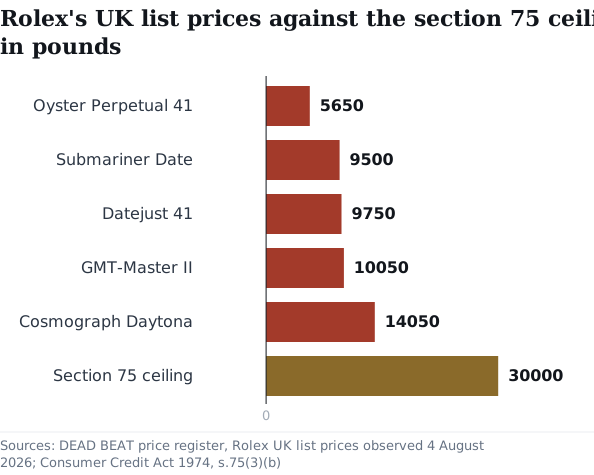
Every steel Rolex in our own price register sits comfortably inside that band — the Daytona at £14,050 is the dearest of them, less than half way to the ceiling. A buyer of a steel sports model on a credit card is as well protected as British law knows how to make them.
Cross £30,000 and it stops. Not tapers — stops. A gold Day-Date, a platinum anything, most of Patek Philippe’s catalogue and a great deal of Vacheron’s fall on the wrong side of a fixed cash figure, and the credit card that would have covered the £29,000 watch covers nothing at all on the £31,000 one.
The usual answer is that section 75A picks it up above £30,000, and the FOS does point there. Read section 75A and it is a much narrower door. It applies to a “linked credit agreement” — defined as an agreement which “serves exclusively to finance an agreement for the supply of specific goods”. A general-purpose credit card does not serve exclusively to finance anything; it is a running-account facility you also buy petrol with. Section 75A also caps out where the credit exceeds £60,260, and it is not joint and several liability at all: the debtor must first show the supplier cannot be traced, has not responded, is insolvent, or has been pursued with reasonable steps and without satisfaction.
Our read, and it is a reading of the statute rather than a decided case: a £40,000 watch bought on an ordinary credit card has neither. Section 75 excludes it on cash price; section 75A wants a kind of credit agreement a credit card is not. Point-of-sale finance arranged through the dealer is a linked credit agreement and does reach it — which produces the counterintuitive result that borrowing from the dealer’s finance partner can leave a buyer better protected than paying with a premium credit card.
If you are buying above £30,000 and protection matters to you, that is the sentence in this piece worth acting on. Ask what credit product is on offer, and get the answer in writing.
Chargeback is not a right
Where section 75 does not reach, people fall back on chargeback, generally with more confidence than it deserves.
Chargeback is not law. It is a rule of the card schemes — Visa, Mastercard and American Express each run their own, and they differ. The FOS is blunt about what that means: “A bank or lender doesn’t have to raise a chargeback. But if valid reasons exist, it can be good practice for them to do so.” Good practice. Not obligation.
It is also short. “You usually have around 120 days to raise a chargeback about goods or services”, measured from delivery or from the date you received something defective or not as described. On a watch whose fault emerges at its first service, 120 days is long gone.
Chargeback is the fallback, and it is a genuine one — it works, often. It is simply not the thing people think they are relying on.
What the platforms actually promise
Platform guarantees are commercial policy. They can be generous, and they can be changed.
eBay’s Authenticity Guarantee is the most concrete of them and worth reading precisely, because the threshold is doing a lot of work: watches sold for $2,000 or more are covered as standard, and eBay routes the watch through independent authenticators before it reaches the buyer. Between $500 and $1,999.99 it is an optional add-on the buyer pays $80 for. If a watch fails, “the item is returned to the seller and a refund is issued”.
That is a real protection and better than nothing by a distance. It is also a company policy rather than a statutory right, it is priced, and it applies to a band. Note where the band sits relative to the section 75 band: the platform is authenticating from $2,000 up, while the statute quietly stops at £30,000. Between them there is a lot of watch.
The paperwork, and which of it is worth anything
We have already published the argument that a full set of papers is no longer evidence of authenticity, because the papers are now faked as competently as the watches. Nothing here revises that.
What has changed is what the paperwork is for. Its value is no longer evidentiary; it is contractual. The document that matters on a grey purchase is the one establishing who sold you the watch, on what date, at what price, in the course of a business — because that is what a section 75 claim, a rejection under section 22, and a claim for unsatisfactory quality under section 9 all rest on.
Keep the invoice. It is worth more than the warranty card. The warranty card tells you about a relationship with a manufacturer you may not have. The invoice tells you about a contract with a trader you certainly do.
Verdict
The honest position is that buying grey in 2026 costs a buyer far less protection than the folklore says, and the loss is in a specific and narrow place. Statutory rights are identical, because they attach to the trader and not the network. What is genuinely given up is the manufacturer’s voluntary guarantee — and how much that is worth is a question we could not answer here, because Rolex, Tudor and Omega all refused us their published terms.
The real exposure is not grey at all. It is buying privately rather than from a business, which removes the Consumer Rights Act entirely; paying by debit or charge card rather than credit, which removes section 75; and buying above £30,000, where the statute stops and the fallback wants a credit agreement most buyers will not have.
Verdict: the risk in a grey purchase is almost never the watch. It is the payment method and the identity of the seller, and both are decided before anybody opens the box.