The numbers from this spring’s auction season are genuinely historic. Phillips cleared roughly $235 million across Geneva, Hong Kong and New York in the first half of 2026 — more than any auction house has done in a full year, ever. An F.P. Journe Chronomètre à Résonance “Souscription” sold for $13.92 million: a record for any independent watchmaker and for any 21st-century watch at commercial auction. An Akrivia AK-06 in steel brought $3.8 million, nearly four times its high estimate. A Kari Voutilainen chronograph estimated at $120,000 sold for $1.8 million.
Independent watchmaking didn’t just perform this season. It was the season. And predictably, the conclusion being drawn across the industry is: independents are the future, the majors are dinosaurs, and every new atelier with a hand-finished balance cock is riding a rising tide.
We’d like to offer a correction, with affection, because we want the independents to win: those auction results are not a verdict on independent watchmaking. They are a verdict on about ten names — and the economics behind those ten names are precisely the economics a new independent cannot have.
What the auction market actually rewards
Look at what the record lots share. Journe’s Souscription pieces: an early, tiny, closed production run from a maker whose modern output is capped and whose early work can never be repeated. Voutilainen, Dufour, Roger Smith: living legends with output measured in dozens per year and decades-long books. Akrivia: a young maker, yes — but one whose founder’s hands are the product, whose production is genuinely constrained by those hands, and whose steel AK-06 is close to unrepeatable.
The auction market is not paying for “independence.” It is paying for verified scarcity with a dead end — output that is finished, capped, or biologically limited. That is why prices explode for early Journe (he cannot make more 1990s watches) and why the same market is far cooler on anything that can simply be ordered again next year.
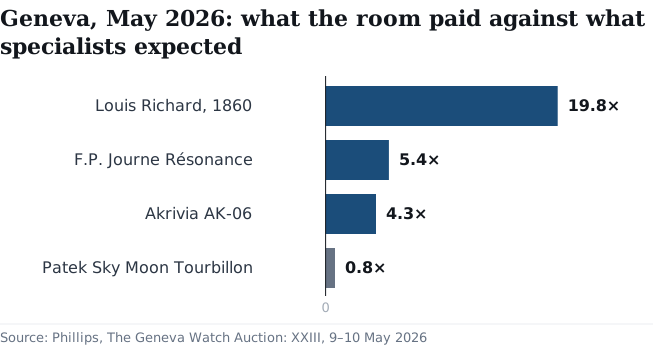
The Geneva sale prices that precisely. Against the specialists’ own high estimates, an F.P. Journe Résonance “Souscription No. 18” made CHF 4,875,500 against a CHF 450,000–900,000 estimate, and an Akrivia AK-06 made CHF 3,000,000 against a CHF 350,000–700,000 estimate. The steepest multiple in the room went to a maker who has been dead for over a century: a Louis Richard triple-detent tourbillon of about 1860 took CHF 3,968,000 against a CHF 100,000–200,000 estimate — roughly twenty times what the house expected. In the same sale a Patek Philippe Sky Moon Tourbillon, a current-production reference a buyer can still order, made CHF 3,242,000 against a CHF 2,000,000–4,000,000 estimate: a large number, comfortably inside the range, and the only one of the four the house called correctly.
That is the whole thesis in one afternoon. The further a watch is from being made again, the further past estimate it goes.
A new independent, by definition, sells the opposite: future output, uncapped by anything except how the business goes. The $13.9 million Résonance is not evidence for that proposition. If anything it’s evidence against it — the money is crowding into the past precisely because it doesn’t trust the future.
The economics nobody puts in the launch deck
Strip the romance off and a young independent brand is a manufacturing business with the worst unit economics in luxury:
- Hand-finishing doesn’t scale. The thing that justifies the price is measured in bench-hours per component. Doubling output means doubling trained hands — and finishers with that skill take years to train and are already employed.
- The waitlist finances nothing. Deposits on a three-year book feel like demand, but they’re an interest-free loan from customers that converts into obligation, not capacity. Plenty of admired ateliers have died of their own order books.
- Key-person risk is the product. Collectors are buying a person’s hands and taste. That’s also a single point of failure for the entire enterprise — and as the Journe market’s obsession with early work shows, even success concentrates value in the founder’s biography, not the company’s future.
- The service tail is decades long. Every watch sold is a promise to maintain a bespoke movement in 2050. The majors amortise that across service networks; an independent amortises it across whoever is still in the workshop.
- The capital now arriving makes it harder. Investment wants growth; the value proposition is the refusal to grow. Squaring that circle usually means quiet outsourcing, a diffusion line, or volume creep — each of which erodes exactly the scarcity the brand was priced on.
None of this is a scandal. It is simply what the business is — and it’s why the honest base rate matters: most independent watch brands founded in any given boom do not survive the following decade. The 1990s independents everyone now venerates are the survivors of a cohort that mostly vanished; survivorship bias is doing heavy lifting in every “golden age” narrative currently being written.
How to tell the survivors — a field guide
Since we intend to cover this scene profile by profile, here is the lens we’ll use — the questions that separate a durable atelier from an aesthetic with a deposit page:
- Where is the movement really from? Genuine manufacturing depth — or an assembled “independence” built on supplied ébauches and rented finishing? Both can be honest businesses; only one supports the price.
- Does output match the story? A “25 pieces a year” atelier with 200 watches surfacing on the secondary market has answered your question.
- Is the order book an asset or a liability? Deposits held responsibly, delivery dates kept, prices not retroactively raised on the loyal.
- Is there anyone else who can do it? A second watchmaker who can finish, regulate, and service to standard is the difference between a brand and a biography.
- What happens to the waitlist when the founder steps back? If the answer is “nobody wants to think about it,” that is the answer.
The boom is real. The craft at the top of it is some of the best ever produced. But $235 million of auction results measure the value of watchmaking that is finished, not watchmaking that is starting — and the kindest thing coverage can do for the next generation of independents is to take their businesses as seriously as their bevelling. That’s what our profiles will do.