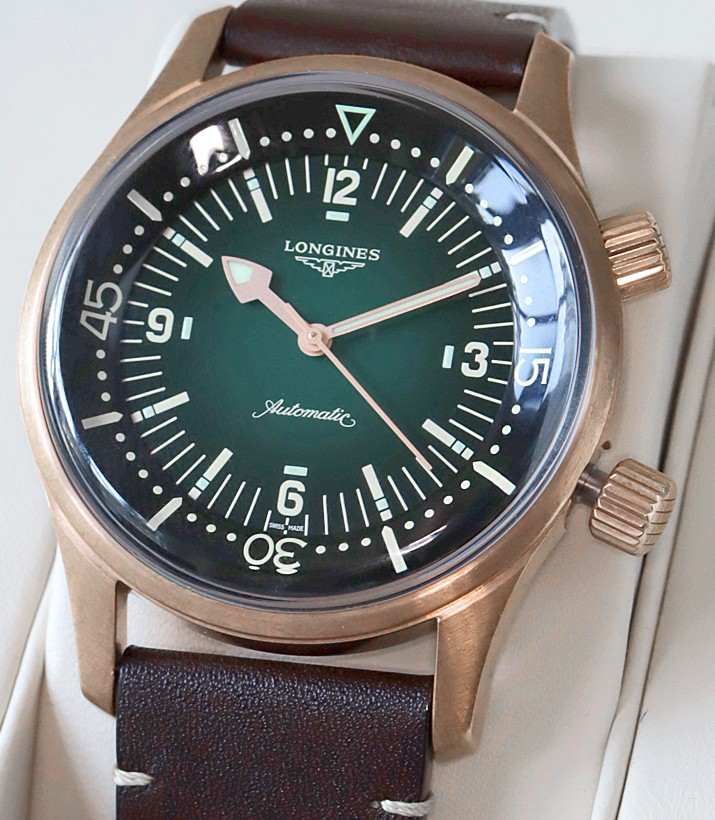
Walk into a Longines dealer and ask for the watch in the window. They will sell it to you.
That sentence is unremarkable in every other industry and faintly astonishing in this one. For roughly a decade, the most desirable Swiss watches were the ones you could not have, and the industry took that as a lesson rather than a symptom. Scarcity was managed, waiting lists were curated, allocation became a customer-relationship strategy, and a generation of buyers learned that wanting a watch and being permitted to buy one were separate problems.
Longines did not participate. It made watches, put them on shelves, and sold them to whoever turned up. On the terms the last decade rewarded, that looked like a lack of ambition. On the terms of the market that has actually arrived, it looks like the single smartest position in Swiss watchmaking.
This is a profile of how a company gets there — which turns out to be less a strategy than a hundred and ninety years of habit — and of the one place the position is fragile.
What can actually be established
Start with the limits, because they matter for everything that follows.
Swatch Group does not publish brand-level revenue. Its reporting is by segment, not by name, which means nobody outside Bienne knows what Longines sold last year, and anyone quoting you a figure is estimating without saying so. That constraint applies to this piece as much as to any other: what follows argues from what is observable — specifications at a price, availability in a shop, the terms of a warranty, the movement inside the case — and says plainly where the observable ends.
What is observable is quite a lot. Reference specifications are published. Certification is either awarded by an independent body or it is not. Stock either exists or it does not. Those are the materials here.
Saint-Imier, and a company that was never a jeweller
Longines traces to 1832 and a watch business run by Auguste Agassiz in Saint-Imier, in the Bernese Jura. The pivotal figure is his nephew, Ernest Francillon, who did something in the 1860s that the industry has spent the subsequent century and a half turning into a marketing word.
Swiss watchmaking then ran on the établissage system: a merchant coordinated a dispersed network of specialists working in their own homes, and assembled the results. Francillon bought land in a meadow outside the village — Les Longines, the long meadows — and in 1867 put the whole process under one roof, with the workers, the tools and the production sequence in a single building. He was not building a manufacturer because it sounded impressive. He was building one because coordinating cottage industry at scale was becoming impossible.
The winged hourglass was registered in 1889 and has not changed since. That is a genuinely unusual fact — most brands in this industry have redrawn their identity several times over — and it is the first sign of the trait that defines the company: Longines rarely reinvents itself, and has never needed to.
The through-line established in that period is the one that matters most for reading the brand today. Longines was not founded to make jewellery for people who wanted a watch. It was founded to make instruments, and it spent its best century doing exactly that.
The instrumental years
The evidence for that is in what the company built when it was at its most inventive.
Longines chronographs — the 13ZN of 1936 and the 30CH that replaced it in 1947 — are among the movements the trade still treats as reference points, and they were built for timing things, not for display. The company timed sporting events, supplied stopwatches, and developed timing equipment as a serious commercial line rather than a sponsorship.
The aviation work is the clearest expression of it. The Weems Second-Setting watch, developed with the American navigator Philip Van Horn Weems, solved a specific navigational problem: a pilot needed to synchronise seconds precisely against a time signal, so the dial was made to rotate. The Lindbergh Hour Angle watch of the early 1930s went further, turning the dial into a calculating instrument for determining longitude in flight. It was designed to the specification of the pilot who needed it.
That is a company being commissioned to solve a problem, which is a different business from a company being asked to signify wealth. It is also the archive the current catalogue draws on, and it is why the reissues work: there is something genuine underneath them.
The long anonymity
Then the part enthusiasts skip.
Quartz arrived, and the Swiss industry’s restructuring took Longines with it. The brand ended up inside ASUAG, one of the two great holding companies assembled to keep Swiss watchmaking alive; ASUAG merged with SSIH in 1983, and the combined business became what is now Swatch Group. Longines emerged from that period as the group’s dependable middle — profitable, competent, and largely anonymous.
For a long stretch it was a brand better known for tennis and equestrian sponsorship than for anything on a wrist, selling a great deal of pleasant quartz to people who were not thinking about watchmaking at all. Nothing about that period was disgraceful and nothing about it was interesting. The instrument company had become a name on a dial.
It is worth being blunt about this, because the current enthusiasm for Longines occasionally reads as though the brand has always been quietly excellent. It has not. It spent a couple of decades coasting, and the recovery is recent enough that its durability is a fair question.
The turn
What changed is specific and checkable, which is the useful thing about it.
Certification moved from exception to expectation. The Record collection, introduced in 2017, arrived COSC-certified across the line — an independent chronometer standard applied as the baseline rather than reserved for a halo reference. COSC testing is run by a body Longines does not control, which is precisely what makes it worth something.
Silicon went down the range instead of up it. Silicon balance springs are effectively immune to magnetism, the most common practical cause of a mechanical watch running badly. Most of the industry introduced them at the top and let them trickle. Longines put them into watches ordinary people buy.
The movements became genuinely exclusive. Longines runs on calibres derived from ETA architecture — the L888 family in the time-and-date watches, the L788 column-wheel chronograph, the L844 in the Spirit Zulu Time — built to its specification and not available to anyone outside the group. This is the point where the marketing gets slippery, and we will come back to it.
The warranty went to five years on the mechanical watches. Longines states the terms plainly: five years on mechanical watches bought from 1 January 2021, twenty-four months on everything else. A longer warranty is partly a marketing instrument, but it is one with a real invoice attached: the company that offers it is the company that pays for it.
The reissues were done properly. The Legend Diver, the Ultra Chron with its 36,000 vibrations-per-hour movement, the Spirit line drawn from the aviation archive — these are cased and proportioned like the originals rather than inflated to modern fashion. Any brand can reprint its own history. Doing it without ruining the proportions requires someone to care.
Put together, the pattern is a company competing on the specification-to-price ratio and nothing else. No allocation, no scarcity, no waiting list, no drop culture. Just more watch per franc than the alternatives, restocked.
The negatives, stated plainly
A piece that only said the above would be an advertisement. Four things cut the other way.
The “in-house” question is where the marketing sails closest to the wind. An exclusive ETA-derived calibre is a real advantage — the specification is Longines’, nobody else can buy it, and the industrial base behind it is one of the strongest in Switzerland. It is not the same thing as a movement conceived from a blank sheet, and language in this industry is regularly arranged so that buyers do not notice the difference. Longines is not the worst offender by a distance. It benefits from the ambiguity all the same.
The range is sprawling and hard to read. Conquest, HydroConquest, Master, Record, Spirit, Legend Diver, Heritage, DolceVita, and a still-substantial quartz business sit alongside each other with no obvious hierarchy explaining which is meant to be better than which. A buyer working out what separates a Master from a Record from a Spirit is not helped by the catalogue.
Resale is weak, and that is the direct cost of the strategy. A brand you can always buy at retail is a brand with no secondary premium; watches that are freely available depreciate. Anyone buying a Longines as a store of value has misunderstood the proposition. That is not a flaw in the watches, but it is a real consequence for the owner, and the enthusiasm around the brand tends to skip over it.
The design account is being drawn down faster than it is being filled. The strongest recent Longines are reissues. The archive is deep and the reissues are good, but a company cannot reissue its way forward indefinitely, and there is not yet much evidence of a contemporary design language that will be worth reissuing in fifty years.
The mirror in the same building
The reason all of this is more than a brand profile is that Swatch Group ran the opposite experiment simultaneously, with Omega.
Omega spent the same period moving in the other direction: up. It pushed hard on technical differentiation — the co-axial escapement, and from 2015 the Master Chronometer certification tested by METAS, which is a genuinely more demanding standard than COSC because it tests the cased-up watch rather than the bare movement. Omega’s technical case is real and it is independently verified. That is worth saying clearly, because what follows is not a claim that Omega makes worse watches.
What Omega also did was reposition itself against Rolex rather than against its own past, and prices moved accordingly. Then in 2022 it put its most famous design onto a plastic Swatch and sold it in queues around the block — an exercise that converted enormous latent demand into volume, at the cost of putting the Speedmaster’s silhouette on every high street in the world.
Two brands. One owner. One components pool. Opposite strategies, run for a decade in public. Nobody sets out to run an experiment that clean.
The honest reading is not that one strategy won. It is that they bought different things. Omega bought margin per unit and a place in a conversation about status. Longines bought a reputation for value. The question worth asking — and this is argument rather than record, because the brand-level numbers to settle it do not exist publicly — is which of those is harder to rebuild once it is gone. A price can be cut. A reputation for being the sensible choice takes twenty years to earn and about eighteen months to spend.
The one way this ends
Longines’ advantage is a price position. That is the whole thing. It is not a technical moat, it is not a design monopoly, and it is not a scarcity story. It is the fact that at its price, nothing else offers as much, and you can actually have one.
Price positions are the easiest asset in this industry to give away, and the mechanism is always the same. A brand does good work, the good work is noticed, the noticing is read as permission, and the prices drift up to meet the new reputation. It happens gradually enough that no single increase looks unreasonable. Then one morning the brand is somewhere it has not earned, its old customers have gone to whoever now occupies the space it left, and the reputation that justified the climb was spent funding the climb.
The signals to watch are unglamorous and entirely public: reference prices at successive catalogue updates, whether certification and silicon stay standard or start reappearing as premium options, and whether any Longines is ever allowed to become difficult to buy. That last one is the real tell. The day a Longines has a waiting list is the day the company has decided it would rather be something else.
Nothing in the current catalogue suggests that is happening. The watches are good, the prices are what they were, and the shelves have stock on them.
Which is why, right now, on the evidence available to anyone who cares to look: Longines is the brand to beat. Not the most exciting, not the most collectable, and not the most technically ambitious. Just the one that has spent a decade quietly being right about what most people actually want from a watch, while the rest of the industry was busy making them hard to buy.