A spare part for a watch is a small piece of hardened steel or brass with a number on the packet. Whether you can buy it has nothing to do with the part. It has to do with a distribution policy, and for most of the watches people care about, that policy says no.
Every independent watchmaker knows this. What almost nobody in the trade knows is that it was tested — with lawyers, for thirteen years in Brussels and Luxembourg, then again in Bern and in London — and that the documents sit in public registers waiting to be read. They are more damaging than the trade’s version of them, in a different direction.
The rule that exists for cars, and was not written for watches
Start with the asymmetry, because it is written down in two regulations.
For cars, under Regulation 461/2010, Article 5(a), an agreement loses the benefit of the block exemption if it has as its object “the restriction of the sales of spare parts for motor vehicles by members of a selective distribution system to independent repairers which use those parts for the repair and maintenance of a motor vehicle.” Your dealer cannot be stopped from selling parts to your local garage. It is a named hardcore restriction with its own regulation.
Now look for the equivalent in the general regime covering everything else, watches included. Regulation 2022/720 mentions spare parts exactly once, at Article 4(f): the hardcore restriction is “the restriction, agreed between a supplier of components and a buyer who incorporates those components, of the supplier’s ability to sell the components as spare parts to end users or to repairers.”
That binds the component maker’s agreement with the company that assembles the components — in watch terms, a brand cannot make a movement supplier promise never to sell that movement’s parts as spares. It says nothing whatever about a brand refusing to sell its own parts. The one provision that looks like a right to repair is a rule about somebody else’s contract.
None of this has to be inferred. When independent watchmakers argued that watches should be treated like cars, the Commission answered that the prohibition on authorised repairers reselling parts to independents “was not expressly regarded by Regulation No 330/2010 as a hardcore restriction, contrary to the provision made for the motor vehicle sector,” and concluded that “the analogy with that sector made by the applicant was therefore not relevant” (T-712/14, paragraph 23).
The analogy fails because the legislature wrote the rule for one industry and did not write it for the other.
It was tested, and it is not new
The trade describes this restriction as quietly permanent — something that settled into place while nobody was looking. Both halves of that are wrong.
On 20 July 2004 the Confédération européenne des associations d’horlogers-réparateurs, nine national associations of independent repairers across eight member states, complained to the Commission about Swatch Group, Richemont, LVMH, Rolex, Audemars Piguet and Patek Philippe. The complaint was precise: not that the brands had never supplied independents, but that most of them once had and had stopped.
The Commission rejected it in July 2008 for want of sufficient European Union interest. In December 2010 the General Court annulled that rejection — the Commission had failed to engage with the evidence put to it, had not reasoned its claim that the sector was economically unimportant, and had made a manifest error in refusing to treat watch repair as a separate market at all. The Commission reopened, widened the file to six more companies, took evidence for three years, and rejected the complaint again on 29 July 2014, this time “on account of the disproportionate nature of the resources which a more detailed investigation would require in view of the low probability of establishing an infringement.” On 23 October 2017 the General Court dismissed the challenge to that second rejection, with Rolex, Swatch Group and LVMH intervening in support of the Commission. The complainants paid everyone’s costs.
Nor is the restriction a decade old. Rolex told the Commission its selective repair system dates to the 1970s, and a letter in CEAHR’s own submission records a repairer whose Rolex parts contract was terminated with effect from January 1985.
The legal test the Court applied is worth quoting rather than paraphrasing, because the paraphrase is where this story goes soft:
to find an abuse within the meaning of Article 102 TFEU, the refusal of the goods or services in question must be likely to eliminate all competition on the market on the part of the person requesting the goods or services, such refusal must not be capable of being objectively justified, and the goods or services must in themselves be indispensable to carrying on that person’s business
Selective repair networks are lawful where the criteria are objective, applied evenly, and go no further than the purpose requires. A refusal to supply is an abuse only if it would eliminate competition altogether.
The table CEAHR filed, and what the courts read into it
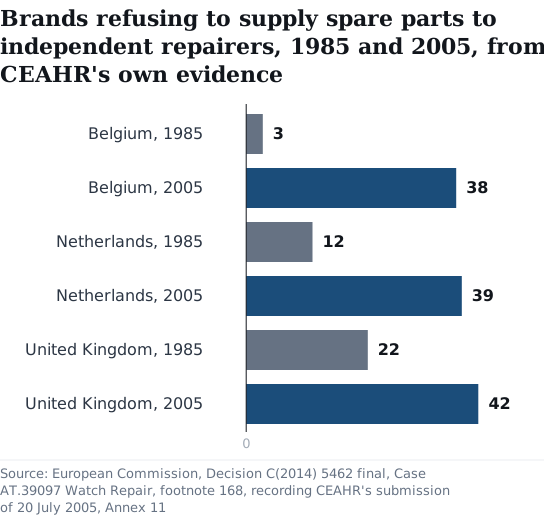
The most useful material in the file is not a total but a timeline. CEAHR submitted its own evidence tracking how many brands operated a closed parts policy, country by country, from 1985 to 2005. The Commission set it out in a footnote, in five-year steps. In the UK: 22 brands in 1985, 24 in 1990, 36 in 1995, 39 in 2000, 42 in 2005. In the Netherlands: 12, 19, 27, 28, 39. In Belgium: 3, 5, 15, 35, 38. Italy appears in the table with no figures against it.
Read across rather than down and the three countries do not move together. Belgium’s count multiplies more than twelvefold while the UK’s does not quite double. The Netherlands is flat between 1995 and 2000 and then takes its steepest jump in the final five years — the same five years in which Belgium’s rise had almost finished.
Both the Commission and the General Court read that table and drew from it the opposite of what CEAHR intended. Not a coordinated policy adopted on one date, but dozens of manufacturers reaching the same commercial conclusion independently across twenty years — “not the result of an agreement, but of a series of independent commercial decisions.”
It is the complainants’ own strongest exhibit, and it is the reason the cartel theory failed.
The sentence in the judgment nobody quotes
The record does contain a holding on the merits, and it is bleaker than the headline version. Paragraph 112, answering the argument that independent benches were disappearing:
The need to preserve undistorted competition therefore does not entail a need to protect the existence of independent repairers as such.
Competition law protects competition, not competitors. An orthodox principle, correctly applied, to a trade of individual craftspeople. Anyone hoping European law harbours a hidden preference for the independent watchmaker can stop looking.
Two further findings from the same file define the market this industry actually operates in. The Commission confined its investigation to watches “sold at a price exceeding EUR 1000”, being those which “for economic and technical reasons, are worth repairing and maintaining.” And it found substitutability of parts across brands “was very limited”, so that there is a separate market for each brand’s spare parts, on which the manufacturers “generally had a market share above 30%.”
Every brand is, on the regulator’s own analysis, close to a monopolist in the parts for its own watches. That finding was not the beginning of a case. It sits in the decision explaining why there would not be one.
Switzerland looked too, and its own staff found something
This part is a public PDF on a federal website, unreported in English. Switzerland’s Competition Commission ran a preliminary investigation, case 32-0256, into after-sales service for watches. Its Secretariat surveyed six manufacturers, a set of independent watchmakers, seven retailers and a trade association, and published a 42-page final report on 8 May 2018. The manufacturers are anonymised. The findings are not.
All six operate selective distribution in sales and in service, and only authorised partners are supplied with parts. Parts are, at paragraph 107, “with the exception of certain standard movements, fundamentally brand-specific and accordingly not interchangeable” — which is why refusing to supply an independent amounts in practice to a prohibition on that bench touching the watch at all.
Two things stand out. The first is a condition: certain manufacturers require, for admission to the service network, that the applicant also sells their watches. A bench with the training, the tooling and the premises can be refused for not also being a shop. Whether that can be justified “cannot be assessed at the present time,” the Secretariat wrote.
The second is about billing. Asked for their 2016 service volumes, several manufacturers could not separate overhauls from repairs, because they carry out repairs within overhauls — and in few cases is a full overhaul what the customer asked for. Then the line: it does not emerge from the answers “in which cases the stated and performed overhauls were also (objectively) necessary.”
A federal competition authority wrote down that it could not tell, from the manufacturers’ own returns, whether the work they billed for was needed. Then it closed the file.
Because that is how it ends. The Secretariat’s conclusions at paragraph 189 are that for manufacturers tying watch sales to service admission the arrangements significantly restrict competition under Article 5(1) of the Cartel Act; that it is “not improbable” those manufacturers are dominant on the brand-specific markets for service and parts; and that their systems “could be regarded as abusive conduct” under Article 7, “namely as a refusal to deal.”
It did not open an investigation. The first reason given is that the central questions had already been assessed in Brussels and upheld in Luxembourg, so a Swiss case “would run counter to the decision of the EU Commission” — followed immediately by the admission that this preliminary investigation “revealed no Switzerland-specific differences.”
Brussels declined because establishing an infringement looked disproportionate. Bern declined because Brussels had declined. Neither decided, and each cited the other’s non-decision as the reason it did not have to.
It was not a one-off. On 6 December 2022 the same Secretariat published its report in case 32-0272, Assortiments, on the escapement components made by Swatch Group’s Nivarox-FAR. It found indications that Nivarox-FAR was dominant, and that by capping quantities to third-party customers and treating group-internal buyers differently it had “unlawfully restricted production and technical development.” Having found that, it “refrains, for reasons of proportionality,” from investigating, and closed. That conclusion cost CHF 86,689.40.
Two files, four years apart, both about who may obtain the parts of a Swiss watch. Both find indications of an abuse. Neither becomes a case.
The one court that could have priced it decided it did not need to
The last tier is the wholesaler, and it went to court too.
Cousins Material House, a UK parts wholesaler, had been supplied by ETA and Swatch Group UK since around 1982. That supply “ceased as from 1 January 2016”. Cousins issued in England, Swatch got the dispute heard in Bern, the Bern court found against Cousins, the Swiss Federal Supreme Court dismissed the appeal, and in March 2024 the English High Court held the Swiss judgments were entitled to recognition under the Lugano Convention. The Bern court’s reasoning, quoted in the English judgment, is that a wholesaler is “merely an intermediate distribution stage” rather than one selling to the end customer.
And then the detail that explains a hole in every piece written on this subject, including this one. Cousins asked the Bern court to order disclosure of the average delivery time for Swatch spare parts from 2016 to 2019, and of “the evolution of prices for repair and maintenance services for the Claimants’ prestige watches in the United Kingdom from 01.01.2010 to 31.12.2019, broken down by brand and type of repair.”
The court refused the requests as unnecessary to its ruling. That was the only forum ever to hold the power to compel the numbers showing what the embargo cost owners, and it decided it did not need them. So they have never been produced. Anyone quoting a figure for what closing the independent channel did to service prices is not quoting a measurement.
Where the critical reading breaks down
The case against the brands on this record is strong. It is not complete, and the parts that cut the other way come mostly from the complainants’ own mouths.
The investment argument was conceded. The General Court records that the complainants accepted that national associations of independent repairers “require their members to make investments in training, tools and stocks of spare parts that are similar to those required by the Swiss watch manufacturers.” If the profession’s own bodies set a comparable bar, a brand setting one is not obviously exclusionary.
The access argument was conceded too. The Court notes the complainants’ assertion that the number of authorised repairers “was necessarily high and increasing,” and observes that this confirms the systems do not require excessive investment, “since they are accessible.” An advocate arguing that authorisation is both unobtainable and widespread has argued itself out of one of those.
Swatch’s own figures cut the same way. It told the Commission it had sent between 10,000 and 20,000 letters to independent repairers who had previously serviced its watches, offering them a route into its authorised network — and that more than half accepted. That is not the shape of a workshop cut off with no way back in.
The unrestricted parts are not a small category. COMCO’s carve-out — “with the exception of certain standard movements” — covers the ETA, Sellita and Miyota calibres that the overwhelming majority of watches actually run. An independent bench in 2026 can obtain what it needs for most of the mechanical watches in the world. What it cannot obtain is what it needs for the expensive ones: a real problem, and a narrower one than “independents cannot get parts.”
And from the bench, the quality argument is not a fiction. The manufacturers told COMCO their systems exist to hold service quality to the standard of the product. Anyone who has opened a watch a confident amateur got to first knows the failure mode: a scored bridge, a stretched mainspring, a cross-threaded case back, a movement running and no longer worth what it was. Movements have got harder rather than easier, and silicon components and proprietary architectures genuinely need brand-specific tooling. The restriction is self-serving and the reason given for it is partly true.
What changed last week, which is nothing
On 31 July 2026 the national measures implementing Directive (EU) 2024/1799, the EU’s repair directive, became applicable. It grew out of the right-to-repair campaigns and it does contain a genuine obligation to repair.
Article 1(3): “Articles 5 and 6 shall only apply to goods for which and to the extent that repairability requirements are provided for by Union legal acts listed in Annex II.”
Annex II lists ten categories: washing machines and washer-dryers, dishwashers, refrigerating appliances, electronic displays, welding equipment, vacuum cleaners, servers and data storage, mobile phones and tablets, tumble dryers, and goods containing light-transport batteries. No watch. The obligation to repair does not reach a mechanical watch, and nothing in the directive requires parts to be made available to anybody.
Prediction, 10 August 2026: watches will not be added to Annex II within five years. The ecodesign framework that populates that list works from energy consumption and volume; a mechanical watch consumes no energy and ships in numbers no regulator will prioritise. If the parts question is reopened it will be reopened by a competition authority rather than a repair law — and on the evidence of 2018 and 2022, only by one willing to spend money establishing something it has twice decided it can guess.
Verdict
The parts embargo is not a grey area, a rumour, or an injustice waiting for someone to notice. It is a documented, examined, twice-declined question, and the documents read worse than the trade’s summary of them because they flatter nobody. The brands’ justifications are real and partly sound. The independents’ case was weakened by their own advocacy and their own strongest exhibit. And two competition authorities each found indications of an abuse in the supply of watch parts, and each decided the finding was not worth the cost of proving.
Our read: what owners have lost is not a cheaper watchmaker. It is the ability to buy a repair rather than a service — the fault fixed, priced and returned, instead of a standard overhaul. Independent watchmakers told COMCO precisely that, and COMCO wrote it down: they can do “those works which are requested by a customer,” where the manufacturers’ process “is to be classified as rather standardised.”
That difference is the cost, and the one court with power to measure it decided it did not need to.
What is not claimed here
That the manufacturers acted unlawfully — no authority has found that, and two declined to look. That the system is a cartel: the courts examined that precise question and rejected it, on the complainants’ own evidence. That the £35,000 tooling figure in circulation is right or wrong; it is untraced, and in the ledger. That independent watchmaking is dying as a matter of counted fact; nobody counts it, which is also in the ledger. And that the six manufacturers named in 2004 behave identically today: the Commission found the systems arrived at different times and that some kept supplying independents, without saying which.