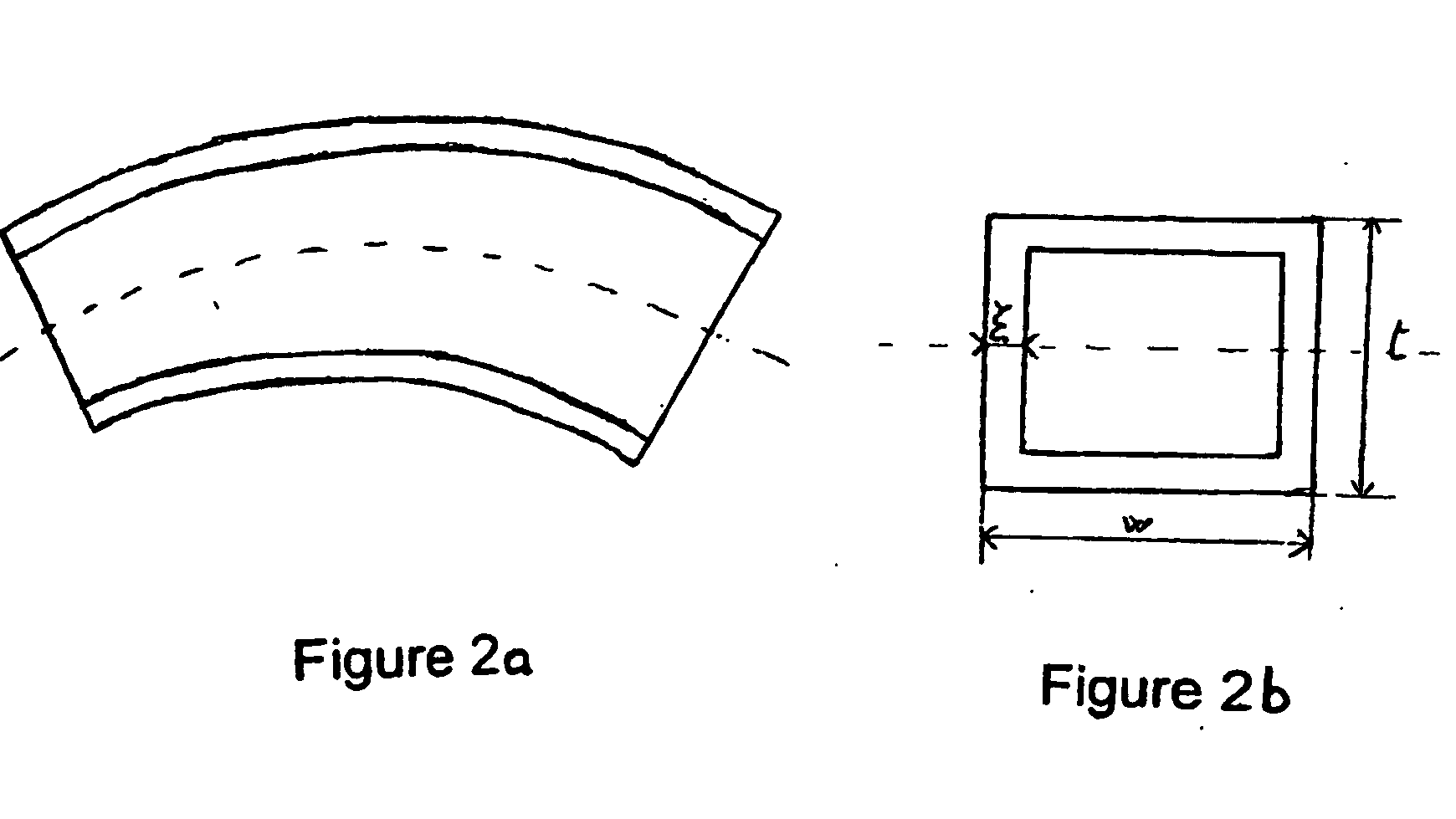
A Tissot with a silicon hairspring costs $950 today. A Patek Philippe with one costs six figures. Ask what the silicon actually buys at either counter and the honest answer is the same two sentences either way — and most buyers never hear even those. Silicon has become the watch industry’s most successful ingredient brand: universally cited, rarely explained, sold as a strict upgrade when it is closer to a trade.
What a hairspring does
Inside every mechanical watch, a balance wheel swings back and forth at a fixed rate, and the hairspring is what makes it swing back. It is a coil thinner than a human hair at its edge, flexing roughly five to eight times a second for years without being replaced. Its stiffness sets the watch’s rate: change how the spring behaves and you change how fast or slow the watch runs. Almost everything that degrades a mechanical watch’s accuracy — magnetism, temperature, position, shock — acts on this one component.
For most of watchmaking history the material was steel, then steel alloys engineered to resist magnetism and drift, of which Nivarox, developed in the 1930s, is the industry standard still cut today. Silicon is the first real change of material in nearly a century. CSEM, the Swiss federal microtechnology research centre, patented the version that made it usable in 2002, in a joint project with Rolex, Patek Philippe and the Swatch Group.
What silicon actually changes
Two things, cleanly, and a third with an asterisk.
Magnetism. Silicon is not ferromagnetic. It does not just resist magnetic fields the way a well-engineered alloy does — it has essentially nothing for a field to act on. CSEM’s patent states this as a property of the raw material, not a design achievement: “this material is non-magnetic.” A steel-alloy hairspring can still be knocked off rate by an MRI machine or a handbag clasp; a silicon one, on its own, cannot.
Temperature — with an asterisk, because raw silicon is bad at this. Silicon’s elasticity changes sharply with heat: CSEM’s patent puts the drift at about 155 seconds a day across normal watchmaking temperatures, against a requirement of roughly 8. Every silicon hairspring sold commercially — Patek’s Spiromax, Rolex’s Syloxi, Omega’s Si14 — solves this the same way: a layer of silicon dioxide grown on the surface, whose elasticity moves opposite to the silicon underneath as temperature rises, cancelling most of the drift. That is the actual invention. “Silicon hairspring” undersells it; what’s patented is a specific composite of silicon and its own oxide.
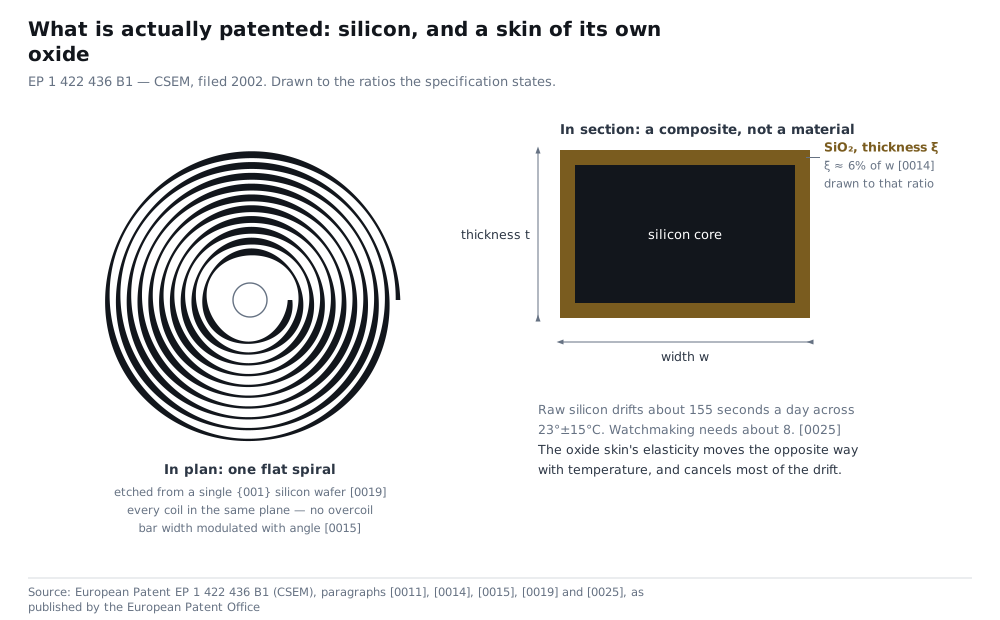
Two details in that drawing are worth pausing on, because both are in the patent and neither is in the marketing. The oxide layer is thin — CSEM specifies it at about 6% of the width of the bar, so the entire temperature compensation is done by a skin roughly a seventeenth of the beam it wraps. And the bar is not a constant-width ribbon: its width is modulated periodically around the spiral, as a function of the angle, to suppress the second-order term the oxide layer alone leaves behind. A silicon hairspring is a more deliberate object than a spiral cut out of a wafer.
Manufacturing precision, and this is the one nobody markets. A silicon spring is etched from a wafer by the same process used for microchips, so every unit from a batch is dimensionally identical. A traditional spring is wound, cut and hand-terminated, then needs a watchmaker to regulate it. Tissot’s own account of its Ballade launch notes the machine-regulated Powermatic 80 needs no regulator index at all — a manufacturing-cost story wearing a technology story’s clothes.
What it does not change
Shock resistance, and here the marketing genuinely muddies two different claims.
A watch’s resistance to physical shock is mostly governed by the anti-shock bearings — Incabloc and its relatives — that cushion the balance staff’s pivots, a system entirely unrelated to what the hairspring is made of. Silicon changes nothing about it either way.
What silicon does change, for the worse, is the spring’s own tolerance for being struck hard. Silicon is brittle: it does not bend and spring back the way a metal coil does, and past its limit it shatters. A trade watchmaker’s technical note on the material is blunt: “silicon is brittle and can shatter under stress.” That is the trade the marketing rarely states as one.
It is also worth being precise about whose claim is whose. The oft-repeated line that a Rolex hairspring is “ten times more resistant to shocks” belongs, where it can be traced at all, to Parachrom — Rolex’s own alloy of niobium, zirconium and oxygen, unveiled in 2005. It is not silicon. Rolex’s silicon hairspring, Syloxi, appears only in its smaller-diameter calibres and carries no such number on Rolex’s own current pages; Parachrom’s own page today says only “resistant to shocks as to corrosion,” no multiple given. The masthead could not find “ten times” stated by Rolex itself, on any date. It goes in the ledger as untraced, with a bounty.
The serviceability question, asked properly
A broken silicon hairspring is not a repair. Steel can be re-formed by a skilled watchmaker on a staking set; silicon cannot be reshaped once it fractures, only replaced, and only the party with access to the etching tooling can make a new one. That is a real constraint on who may service a watch fifteen years from now, and it belongs in the buying decision rather than a footnote.
Nor is the field wholly open now. CSEM’s core patent lapsed on 25 November 2022 — but it covered one specific composite geometry, not “silicon,” and narrower patents on other geometries remain in force: a 2016 filing by Master Dynamic Ltd on a different crystal orientation runs to 2036. Enforcement has been real: in 2019, three years before the base patent expired, Switzerland’s Federal Patent Court found a components maker supplying the independent brand Horage had infringed CSEM’s patent with a differently oriented spring, and granted interim relief against it. An earlier fight between the CSEM consortium and Ulysse Nardin’s Sigatec venture was settled confidentially in 2013 — cross-licensing the core group, and settling nothing about anyone outside it.
The industry’s own response to the brittleness problem is the best evidence it is real. Swatch Group and Audemars Piguet jointly developed Nivachron, a titanium-based alloy that keeps most of a spring’s traditional malleability while cutting magnetic sensitivity by what SJX reports as a factor of 10 to 20 — short of silicon’s immunity, but a genuine gain, and now fitted across brands including Tudor. TAG Heuer has spent a decade on a carbon-fibre composite spring for the same reason. Two large manufacturers chose to solve magnetism without silicon’s brittleness, which is a more honest verdict on the trade-off than either has put in a press release.
Where it has actually landed
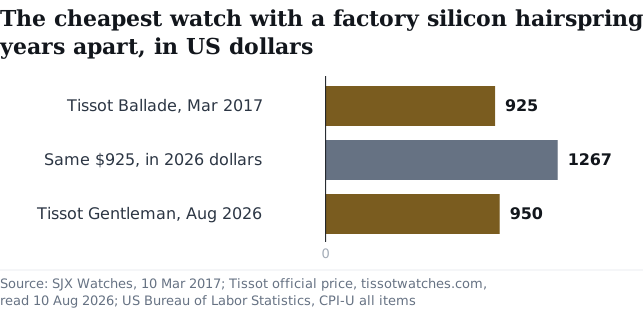
Tissot’s Ballade Powermatic 80 launched with a silicon hairspring at $925 in March 2017 — reported then as the cheapest watch on the market with one. Today’s equivalent, the Gentleman Powermatic 80 Silicium, lists at $950. Inflation alone, on the US Bureau of Labor Statistics’ own index, would put the 2017 price at roughly $1,267 in today’s dollars. The nominal price of entry-level silicon barely moved in nine years; the real price fell by about a quarter, and no catalogue advertised that — it takes an index to compute, not a press release to print.
What to weigh it as. Our read: silicon buys manufacturing consistency and total immunity to magnetism, at a real cost to independent repairability and no demonstrated gain to overall shock survival — that part is a trade, not an upgrade, whichever way you’d take it. Wanting a watch a local watchmaker can still service in thirty years argues against silicon. Wanting one a phone case magnet cannot touch, at a price now nearer $950 than $5,000, argues for it.