
Open Swatch Group’s half-year report to the segment table, which is where a reader who wants numbers rather than adjectives eventually ends up. There are two operating segments. Watches & Jewelry did CHF 2,951 million in the first six months of 2026. Electronic Systems did CHF 174 million. Corporate, which is not a segment and is shown separately, did four.
That first number is the entire watch business. Breguet, Blancpain, Harry Winston, Glashütte Original, Jaquet Droz, Omega, Longines, Rado, Union Glashütte, Tissot, Balmain, Certina, Mido, Hamilton, Swatch and Flik Flak — the sixteen brands Swatch Group lists under Watches & Jewelry on its own site — plus the movement plants that supply half the country. One line.
This is not an accident and it is not a violation. The group says why, in the notes: operating segments are reported consistently with the internal reporting provided to the Management Board, and the main entrepreneurial focus remains on the product portfolio. That is the accounting standard working as designed — segments follow how the business is actually run, not how outsiders would like to slice it. Plenty of listed groups do the same.
The interesting part is what happens in the space that leaves.
Adjectives where the numbers should be
The half-year report has a section headed Brands. It is worth reading closely, because it is a masterclass in saying something while disclosing nothing.
Breguet “had an excellent half year in a challenging environment for luxury brands.” Harry Winston “achieved outstanding sales in all regions.” Longines, Tissot and Hamilton, taken together in a single sentence, had “two digit turnover increases” and “impressive growth.” Swatch “has once again shaken up the world of watchmaking.”
Four brand paragraphs, and the precise figures in them are these: Harry Winston grew nearly 20% at constant rates in China; Omega grew 20% at constant rates in its retail business, which is now 42% of the brand’s turnover; and the Royal Pop campaign generated more than 25 billion views on social media.
So the report will tell you a channel’s growth rate, a region’s growth rate, and a video view count. It will not tell you what any brand sold.
Set that against the geographical disclosure two notes later, where Greater China is given as CHF 1,465 million in 2025 against CHF 1,833 million in 2024 — a fall of 368 million, stated to the million, no adjective required. The group is perfectly capable of precision. It applies it by geography and withholds it by brand, and both choices are deliberate.
The market-share claim, which depends on which number you pick
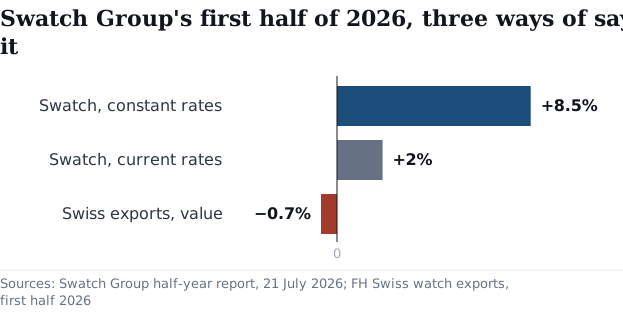
The headline on the half-year release is “Strong sales growth and important gains in market shares.” The evidence offered for the second half of that sentence is a parenthesis: “Very important global market shares gains (vs watch exports according to the Federation of the Swiss Watch Industry after six months: -0.7%).”
The comparison is between the group’s +8.5% at constant exchange rates and the industry’s -0.7%. But the group’s own key figures give a second number for the same six months: +2.0% at current rates, the rates it actually invoiced, after currency effects of nearly CHF 200 million.
The FH series is not currency-adjusted. It is Swiss francs, as exported. So the like-for-like comparison against -0.7% is +2.0%, not +8.5% — and the gap is real but a good deal narrower than the headline implies. Both Swatch numbers are published, in the same table, four lines apart. Neither is hidden. The choice is simply which one goes next to the industry figure.
Our read: this is not a false statement, and calling it one would be lazy. It is a true statement assembled from the more flattering of two available truths, which is what investor relations is for. Readers should know it is happening; the FH data has its own version of the same problem, where value fell while volume rose and the headline reported one of them.
There is a smaller instance a page earlier. The highlights give the Watches & Jewelry segment an operating margin of 9.0% — but that is the segment excluding Production. The audited segment table, which includes it, says 4.1%. Both are disclosed. Production’s size is not, so the two cannot be reconciled by a reader.
What Royal Pop did to the noise, and what it did to the numbers
The pitch for this piece asked a question the report almost answers: what the Swatch collaborations do to the accounts, as distinct from what they do to the conversation.
On the conversation, the report is expansive. The Audemars Piguet collaboration launched on 16 May, demand “far exceeded supply”, the campaign generated more than 25 billion views, and it pulled in new customers “sometimes very young and who take interest for the first time in a mechanical watchmaking product.” It also, the group says, boosted sales of the MoonSwatch and of the Blancpain collaboration.
On the accounts, there is nothing. Not a unit count, not a revenue contribution, not a margin — for the single most visible product launch in mainstream watchmaking this year, inside a segment that grew CHF 64 million.
Two readings are available and the honest answer is that a reader cannot choose between them from this document. Either the collaborations are commercially enormous and the group has no interest in helping anyone size them; or they are a marketing instrument whose effect is chiefly on footfall and attention, and the sales number would be underwhelming next to twenty-five billion views. The report is compatible with both, which is presumably comfortable.
What can be said is narrower and firmer: the group measured the views precisely enough to report them to the billion, and did not report the units at all. Where a company chooses to be exact is itself information.
And then the group published the numbers after all
In February 2026, Morgan Stanley released the ninth edition of its annual Swiss watch industry report, written by the consultancy LuxeConsult, which estimates revenue, unit sales and market share brand by brand. It is the study the trade quotes all year, precisely because it fills the vacuum the accounts leave.
Swatch Group responded with an open letter, published on its own investor pages on 27 February. It is a furious document, and in the course of being furious it discloses more about individual brands than the annual report has in a decade:
- Estimated turnover for its brands deviates from actual by 24% on average, ranging from -53% for Certina to +46% for Rado. Of the twelve Swatch Group brands in the report, only six are within ±20%, and four are more than 40% out.
- Unit-sale estimates are worse. For Hamilton, actual unit sales are three times the figure printed.
- Breguet’s share of sales through its own retail: the research assumes 22%; the actual figure is 54%.
- Longines’: research 10%, actual 24%.
- Hamilton’s average retail price: research CHF 2,014; actual CHF 741.
- The research says Tissot declined 5% in 2025. Tissot grew 3%.
- And the one that clearly stung: the research called Longines “loss making in 2025” and “Swatch Group’s main problem child”. The letter’s answer is flat — Longines reports a profit of 16.6% on net sales in 2025.
A brand-level net margin. Published, on the record, by a company whose financial statements do not contain a single brand-level figure.
Morgan Stanley’s reply, dated 5 March and published by Swatch alongside its own letters, concedes the point without meaning to: “Your letter includes additional detail relating to certain Swatch Group brands that was not previously disclosed publicly.”
That is the whole story in one sentence, and it comes from the other side.
The uncomfortable part: the complaint is largely right
A piece that stopped at the irony would be cheap, so here is the counterweight, and it is substantial.
The letter’s methodological criticism is the criticism this masthead makes constantly. It objects to point estimates presented where ranges are honest — “Reputable studies would use ranges, not point estimates, when data is fragile. However, single numbers make for more striking headlines.” It objects to five cited sources of which two are reliable and irrelevant to the question, and three are conversations. It objects to a chain of assumptions — turnover, then units, then implied average price — where each layer inherits the error of the last, and gives a worked example: Breguet’s implied retail price doubled between editions while the turnover estimate stayed put, so unit sales were quietly halved to make the arithmetic close.
Every one of those is a fair hit. If a figure’s provenance is a conversation, it is not a measurement, and dressing it as 16.1% rather than “somewhere in the mid-teens” is the false precision this publication keeps a ledger about.
The letter is also not immune to it. On its first page the average deviation in unit-sale estimates is 39%; four paragraphs later, the same statistic is 35%. A rebuttal built on the other side’s arithmetic being loose should be able to state its own the same way twice.
What a reader should take from this
Three things, and only the first is about Swatch.
The brand-level numbers exist. They are known to the company, they are exact, and they are releasable — the letters prove all three. What governs their release is not confidentiality but utility to the company on the day.
The estimates that fill the gap are worse than they look. Not because the analysts are lazy but because the inputs are conversations. When you next read that a named brand did a named number, remember that the one company able to check said the range of error ran from -53% to +46%, and that this is the company whose data is most accessible. For privately held brands, the letter notes, the deviations are likely larger still.
And a vacuum is a choice. Swatch Group can close this argument in a single line of a single report, any half-year it likes. Until then it is entitled to its silence, and equally entitled to be asked why the only brand-level truth it has published in years arrived as a weapon rather than as a disclosure.
What we are watching: whether the 2026 annual report carries any brand-level figure at all, now that Longines’ margin is a matter of public record because the company put it there. Our honest guess, dated 8 August 2026 and offered as a prediction rather than a finding: it will not, and the next brand number out of Biel will arrive in another letter.