
Last week the Federation of the Swiss Watch Industry (FHS) published its first-half 2026 statistics. The headline number: exports down 0.7% to CHF 12.8 billion. Cue a hundred articles about an industry “in mild decline.”
The export statistics are the closest thing this industry has to public financial disclosure — most of its biggest players, Rolex included, publish nothing — which is exactly why they deserve to be read properly. So here is the working guide, using the numbers on the table right now.
Rule one: exports are sell-in, not sell-through
The single most important thing about FHS figures: they measure watches leaving Switzerland, valued at export (wholesale) prices. They do not measure watches being bought by human beings. Between the export dock and a customer’s wrist sits months of distribution pipeline — brand subsidiaries, distributors, retail stock rooms.
That gap is where the misreadings live. A strong export month can mean strong demand — or a brand stuffing its channel ahead of price rises, new-model launches, or, as we’ll see, tariffs. A weak month can mean weak demand — or retailers digesting inventory they over-ordered last year. Exports lead retail reality by six to eighteen months, in either direction, and sometimes they simply lie about it.
Rule two: base effects can manufacture any headline you like
The H1 2026 data contains a perfect specimen. The United States, the industry’s largest market, shows exports down a dramatic 14.8%. Crisis in America? No: in April 2025, shipments to the US spiked roughly 150% as brands raced stock across the border ahead of announced tariffs. Any 2026 figure was going to look terrible against that artificial mountain. Measure across two years instead and the US is up 2.6% on 2024 — a boring, robust market wearing a crisis costume for accounting reasons.
The FHS itself flags this in the release. The headlines mostly didn’t. When a percentage looks dramatic, the first question is never “what happened this year?” — it’s “what happened last year?”
Rule three: value and volume disagree for a reason
H1 2026: value down 0.7%, but unit volumes up 2.3% — over seven million watches, 162,000 more than last year — with the growth overwhelmingly in mechanical watches priced under CHF 500 at export, up 23.8%.
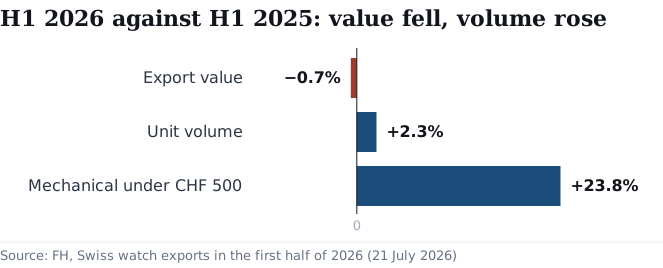
Value/volume divergence is where the actual industry news usually hides. More watches for less money means the mix is shifting downmarket — in this case a striking revival at the entry end of Swiss mechanicals, while the luxury middle treads water. A luxury industry’s headline number can be held up (or dragged down) entirely by price increases or mix shifts without a single additional customer appearing. Always ask which of price, volume, or mix is doing the work.
Rule four: the market table is a map of pipelines, not passions
China: down 5% in H1, and now the industry’s sixth-largest market — from second place at the end of 2024. That collapse is real and structural, and it’s reshaping where inventory flows. But even here, remember what’s measured: exports to Hong Kong and Singapore have long served customers from everywhere; a “market” in this table is a shipping destination, not a nationality. Travel retail and daigou flows blur the map further.
And a market of one: no line in the FHS table tells you anything specific about Rolex, which is roughly a third of the entire industry by most estimates and publishes nothing. The public numbers are the industry minus its centre of gravity, plus everyone else’s channel decisions, averaged.
Rule five: one month is noise
June 2026 exports rose 11.2%, and the trade press dutifully reported green shoots. June has fewer working days some years than others; a single big brand shifting a product launch moves a monthly print; tariff deadlines distort everything for weeks around them. The FHS data is genuinely informative on a horizon of quarters and years. On a horizon of one month it is a random-number generator with a press release.
The honest summary of H1 2026
Read properly, the current numbers say: a flat industry overall, not a declining one; a genuinely healthy US market disguised as a collapsing one by last year’s tariff panic; a Chinese market whose decline is real, deep, and no longer deniable as temporary; and a quiet volume boom in cheap Swiss mechanicals that nobody’s luxury-obsessed coverage has priced in.
That last one is the sleeper. When the growth in Swiss watchmaking is at CHF 500 and below while the prestige middle stagnates, questions follow about where the next generation of buyers enters the market — and whose marketing is actually reaching them. We’ll be returning to that.
The export statistics are good data. They’re just not the data the headlines claim they are. Six weeks from now there’ll be another release, and another round of confident misreadings. Now you can grade them.