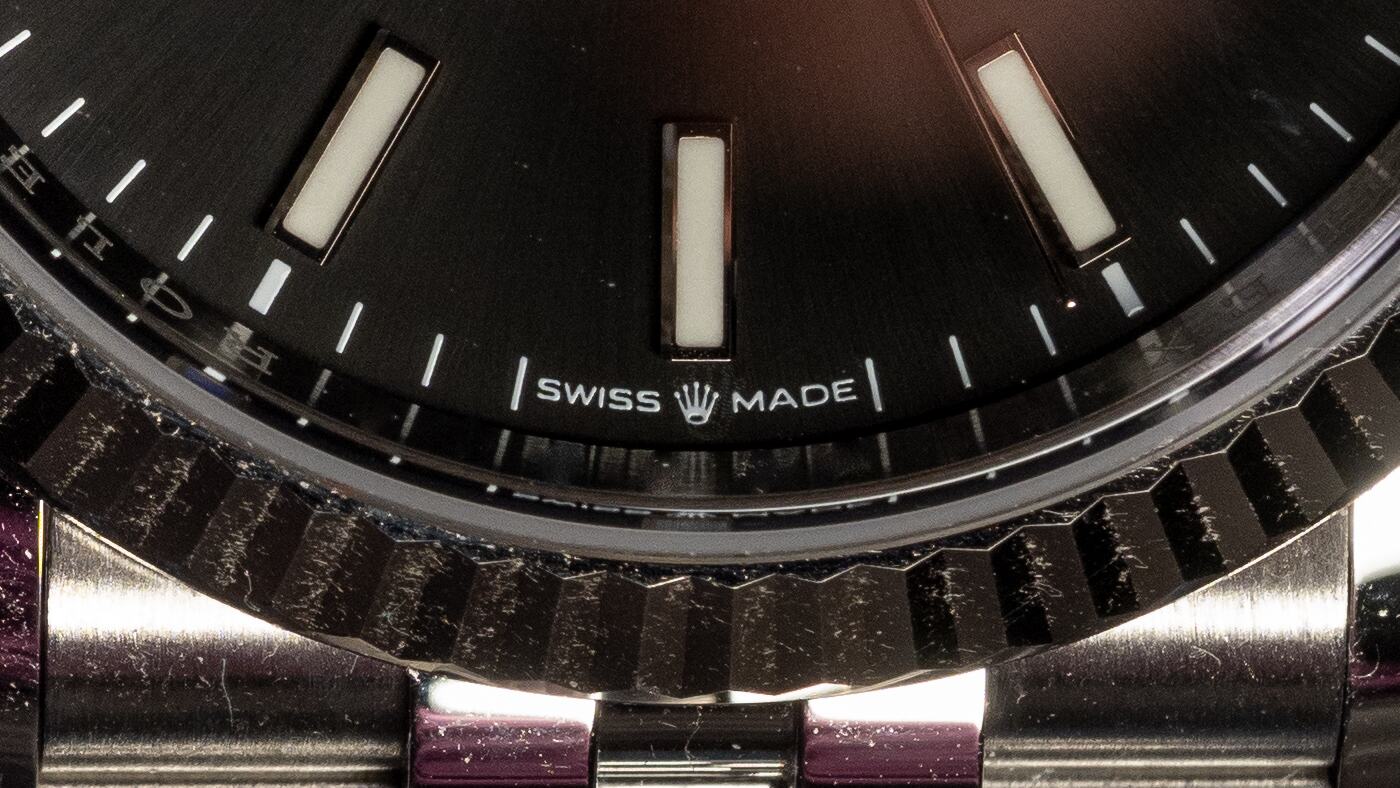
There are two words printed at six o’clock on a great many dials, in type small enough that most owners have never actually read them on their own watch. They are the most valuable two words in the industry, they are governed by a federal ordinance that has been in force since 1 January 1972, and breaching them is a criminal matter.
They are also, in the end, the output of a sum.
That is not an accusation. It is the design. The Swiss state could not write a rule that says made in Switzerland by Swiss hands without defining hands, and so it wrote a rule that counts money instead. Understanding what the label promises means understanding what the sum adds up and — much more interestingly — what it leaves out.
The five conditions
The ordinance sets out what makes a watch Swiss in one article, and it is short enough to hold in your head. A watch is Swiss if its technical development is carried out in Switzerland; if its movement is Swiss; if that movement is cased up in Switzerland; if the final inspection is conducted by the manufacturer in Switzerland; and if at least 60 per cent of the manufacturing costs are incurred in Switzerland.
Four of those are process requirements, and they are the part of the label most people underrate. The design work and prototyping happen there. The movement goes into the case there. The watch is signed off there. Those are real activities that cannot be relocated by an accountant, and a great many products sold on a national association wear nothing like them.
The fifth is the percentage, and the percentage is where the interesting reading is, because a percentage is only meaningful once you know its denominator.
The industry publishes the arithmetic. It gets two answers.
The Federation of the Swiss Watch Industry — the trade association, not the regulator — publishes a forty-one page guide in English on how to apply the ordinance. On page 18 it gives a worked example: a watch with seven cost lines, plus casing-up, research and development, and storage.
The components are these. A movement costing CHF 150 that is 70% Swiss. A complete case at CHF 100, 80% Swiss. A dial at CHF 50, fully Swiss. Hands at CHF 20 and a glass at CHF 20, both 0% Swiss. A crown at CHF 15, half Swiss. Pushpieces at CHF 20, fully Swiss. Then CHF 70 of casing-up in Switzerland, CHF 5 of Swiss research and development, and CHF 1 of storage. Total manufacturing costs: CHF 451.
Then it runs the same watch twice.
Variant 1 takes each component at its actual Swiss share. The movement contributes 70% of CHF 150; the crown contributes half of CHF 15. The Swiss value comes to CHF 338.50, and the watch is 75% Swiss.
Variant 2 is also permitted. It rounds each component to all or nothing: anything 60% Swiss or more counts as 100%, anything below counts as zero. The 70%-Swiss movement now contributes its entire CHF 150. The 80%-Swiss case contributes its entire CHF 100. The half-Swiss crown contributes nothing at all. Swiss value comes to CHF 396, and the same watch is 87% Swiss.
Same components. Same costs. Same factory. Twelve points of Swissness, created and destroyed by a choice of method. A manufacturer may not mix the two within a product line, which is a real constraint and worth saying — but it may pick the one that flatters, and nothing on the watch records which it picked.
Note also what the example is relaxed about. In the industry’s own illustration, the hands and the crystal are entirely foreign, and the watch clears the bar by fifteen or twenty-seven points depending on the method. That is not a loophole being exploited; it is FH showing its members what a comfortably compliant watch looks like. It happens to be the clearest possible statement of what the label does not mean.
What is not in the sum: the bracelet
Article 1 of the ordinance defines a watch, and paragraph 3 removes from that definition “the component that enables the watch to be worn.”
The bracelet is therefore not part of the watch, and its cost is not in the 60% at all. FH’s guide is explicit about the consequence and goes further: even the labour of fitting the bar and attaching the bracelet comes out of the cost price. And in the case of a foreign bracelet permanently soldered or riveted to a Swiss watch — which the guide allows to carry the Swiss made marking, by analogy with cases — it notes that the bracelet’s manufacturing costs are still excluded from the calculation.
So a steel bracelet, which on an integrated-bracelet sports watch can be a substantial fraction of what the object costs to make, is invisible to the test in both directions. It cannot help a marginal watch across the line and it cannot drag a compliant one below it.
The guide even supplies the marking that results, which is worth quoting because no brand would ever put it in an advertisement: a Swiss bracelet on a foreign watch may say “Swiss bracelet” on its back, accompanied, in FH’s own words, by “the clearly legible indication ‘Made in China’ on the watch itself.”
What is not in the sum: the exclusions
The ordinance then removes several categories from manufacturing costs outright. Packaging. Transport. Commercialisation, marketing and customer service. The battery. Natural products that cannot be produced in Switzerland for natural reasons. And materials which, for objective reasons, are not available in Switzerland in sufficient quantities — up to their unavailability rate.
The first three of those cut the manufacturer’s way and against it at once, and this is the part the cynical reading gets backwards. Excluding marketing from the base means a brand cannot inflate its Swissness with Swiss advertising spend. That is a tightening, introduced deliberately, and it is why a watch is not made more Swiss by being sold harder in Switzerland.
The materials exclusion is the substantial one, and it has a document behind it that almost nobody has read.
The list
The ordinance permits the industry to publish a list of materials unavailable in Switzerland, and requires that the list be objectively justified. FH runs the register, with an application form, a stated percentage of unavailability for each entry, and a dispute procedure.
The current list has thirty entries and is dated 18 September 2025. Among them:
- Stainless steel 1.4404 and 1.4435, to the semi-finished stage — plate, bar, strip and wire — declared 90% unavailable, registered in September 2017. These are the 316-family steels that most Swiss watch cases and bracelets are machined from.
- Titanium grade 2 and grade 5, likewise to semi-finished stage: 95% unavailable.
- Bronze of the nickel-free copper-aluminium type, semi-finished: 100%.
- Silicon for integrated circuits, and SOI wafers: 100%.
- Multiphase CoNiCr alloys for springs: 100%.
- Aluminium-oxide powder for sapphire: 100% — though the grown monocrystalline sapphire itself is only 10% unavailable, and finished components made from it are recorded as fully available in Switzerland. The distinction matters and the list makes it carefully.
- Technical ceramic and cermet base powders: 100%. Hard coatings of the TiN, TiCN, CrN and AlTiN families: 90%.
- Mother-of-pearl preparations: 100%. Synthetic diamonds by HPHT and CVD: 100%. And, added most recently, Damascus steel: 100%.
Read that list next to a modern specification sheet and the shape of it is clear. The materials a brand is most likely to name in its marketing — the ceramic, the titanium, the bronze, the silicon, the sapphire, the diamond — are very largely materials the industry has formally recorded as things Switzerland does not supply. That is not hypocrisy. It is metallurgy, and Switzerland has no bauxite, no titanium sponge industry and no reason to have one. But it does mean the 60% is calculated over a base with those costs stripped out to the declared rate, and the phrase “60% of the manufacturing costs” carries an assumption about which costs that almost no buyer makes.
The counterweight, which is real
A piece that stopped there would be dishonest, so here is the provision that cuts the other way.
The movement has a second test alongside the 60%: the constituent parts made in Switzerland, excluding the cost of assembling them, must be at least 50% of the value of all the constituent parts. And FH’s guide states plainly that none of the exclusions apply to that calculation — not the unavailable-materials list, not the natural-products carve-out. Every part counts at its value whether or not Switzerland could have made it. The guide gives the reason in one line: it prevents a weakening of the Swiss made concept.
So the two tests are deliberately different instruments. One counts money and forgives what the country cannot produce; the other counts parts and forgives nothing.
The direction of travel is also worth stating, because it is upward. FH began the process of strengthening the label in 2007. The revised ordinance in force from 1 January 2017 introduced a minimum value criterion for the watch, where previously only the movement had one; raised the movement’s rate from 50% to 60%; and added research and development and mandated certification costs to what counts as Swiss value. The technical-development requirement came fully into force on 1 January 2019. Whatever the label meant in 2010, it means more now.
A note on which language governs
Two small things that are not incidental.
The ordinance’s English version carries a standing notice: English is not an official language of the Confederation, the translation is for information only, and it has no legal force. The rule that shapes what English-speaking buyers believe about a Swiss watch does not exist in English in any binding form.
And the materials list — the document that determines which foreign costs may be left out of the sum — is published only in German and French. Its German version closes with a line stating that the French version is the binding one. Everything above is therefore a translation of a translation of a rule about a phrase written in English on the dial.
What the label actually guarantees
Precisely this, and it is worth having: that the watch was designed and prototyped in Switzerland, that its movement met a Swiss test, that the movement was cased up there, that a Swiss manufacturer performed the final inspection, and that a majority of the countable manufacturing cost was incurred there — countable being a defined term that excludes the strap, the box, the advertising, the battery, and material Switzerland does not make.
What it does not guarantee is that any particular object in your hand was made in Switzerland. Not the crystal, not the hands, not the coating, not the bracelet, not the steel the case was cut from. In FH’s own worked example, the hands and the glass are foreign and the watch is 87% Swiss.
Our view, and it is a view: the label is better than its detractors say and narrower than its users imply, and the honest response is neither to dismiss it nor to pay a premium for it in the abstract. It is a floor, set by law, tested by arithmetic, and rising. Treat it as evidence that a set of activities happened in a particular country. Do not treat it as an inventory.
If you want to know where the parts came from, the label will not tell you, and no version of it ever will. For that you have to find a brand willing to write it down — which, as we have noted before, almost nobody does.