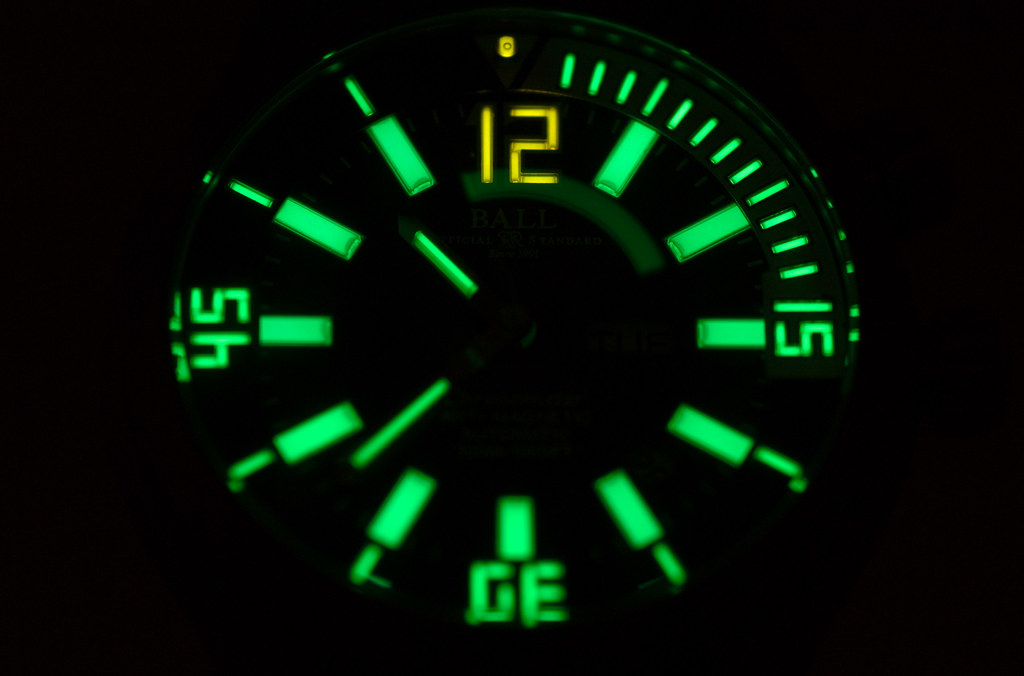
The product page for Ball’s Engineer Hydrocarbon Submarine Warfare has a heading that reads “Micro gas tubes”, and under it one line: “16 micro gas tubes on hour, minute and second hands, dial and bezel for night reading capability.” The word tritium does not appear on the page. Neither does the word radioactive.
Down the hall, screwed to the ceiling, is a smoke detector. If it is the ionisation kind sold in the United States, its case has to say, in so many words, “CONTAINS RADIOACTIVE MATERIAL”, name the isotope and the quantity, and say who licensed it — and the box it came in has to say the same. That is 10 CFR 32.15(d)(2). Its ceiling is one microcurie of americium-241.
The paragraph immediately above it, 32.15(d)(1), sets the general rule that each unit be labelled so the radioactive material in it can be identified. It then exempts, by name, “timepieces or hands or dials containing tritium or promethium-147”.
That is the whole story in two sub-paragraphs. The rest is what is in the tubes, how the rules got there, what the brands choose to say, and why the regulators are probably right about the risk.
What is in the tubes
A tritium watch does not use paint. It uses gaseous tritium light sources: borosilicate glass capillaries coated inside with phosphor, filled with tritium gas and laser-sealed. Tritium is hydrogen with two extra neutrons. It decays to helium, emitting a low-energy electron, with a half-life of 12.32 years, as trigalight puts it. The electron hits the phosphor; the phosphor glows. The glass stops the electron. That last point carries most of the safety case.
mb-microtec, the Swiss company behind the trigalight tubes and owner of the traser brand, publishes the activity of each standard watch tube. Its watch-lights product sheet lists eight round-section tubes from 0.027 GBq (0.50 × 1.30 mm) to 0.135 GBq (0.65 × 6.60 mm), and a rectangular one at 0.189 GBq. A gigabecquerel is a billion decays a second. Add up a dial’s worth and you get the figure that matters: a typical Swiss design in the NRC’s own 2001 assessment used 14 tubes holding “a total of about 1.9 GBq (50 mCi)” (NUREG-1717, §2.14.2.1).
So a tritium watch is a sealed radioactive source of around a gigabecquerel, sometimes several. The regulators agree; that is why each of them has a number for it.
The ceilings, which are written down
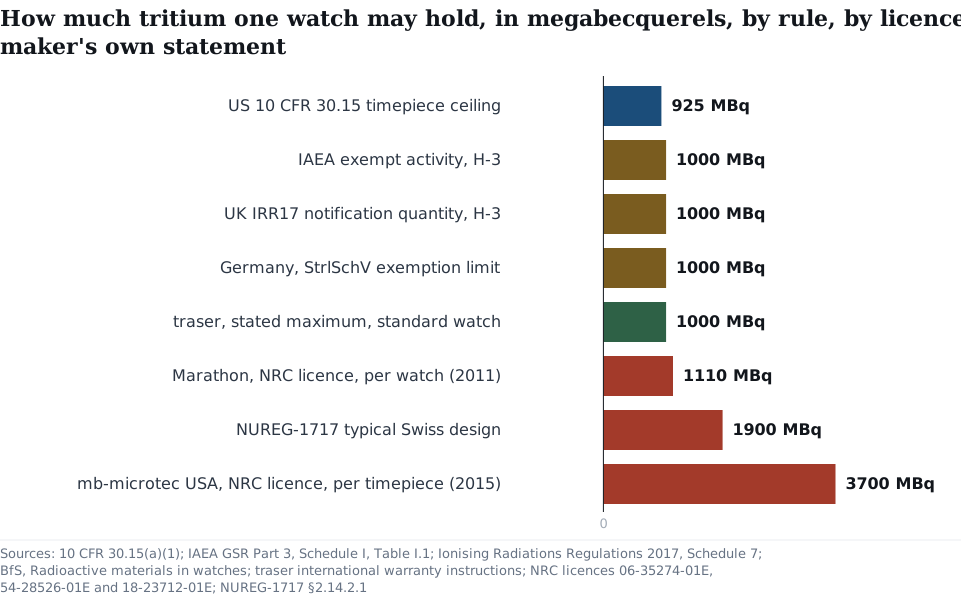
The international baseline. The IAEA’s Basic Safety Standards, GSR Part 3, set the exempt activity for tritium at 1 × 10⁹ Bq — one gigabecquerel (Schedule I, Table I.1). The same document’s definition of a consumer product names “luminous dials” as an example.
Germany holds the line there. The federal radiation office, BfS, says some watches on the market carry up to 15 tubes and 1.9 GBq, “exceeding the exemption limits of 1 GBq” of the Radiation Protection Ordinance, and that “these watches are not allowed to be sold in Germany.”
The United States has two routes. Under 10 CFR 30.15(a)(1), anyone may own a watch holding no more than 25 millicuries of tritium (925 MBq), with sub-limits of 5 mCi a hand and 15 mCi a dial. The company that first sells it needs a licence; the buyer needs nothing. GTLS watches were let into that route in 1998, by a final rule written in response to a petition from mb-microtec, which had told the NRC that the existing regulations were “overburdensome and counterproductive”. The second route, 30.19 with a distributor licensed under 32.22, sets no per-watch number in the regulation at all; the number lives in each licence. The 1998 rule notes that watches holding “up to 200 mCi” had been approved that way.
The licences are public, and they say what you would expect from the chart:
- Plus, LLC, of Stamford, Connecticut, holds licence 06-35274-01E to distribute named Luminox series under 30.15, “containing not more than 25 millicuries of hydrogen-3 per timepiece”, with tubes from mb-microtec listed by model number.
- Marathon Watch Company’s licence 54-28526-01E, as amended in 2011, allows 30 millicuries (1,110 MBq) per listed model under the 30.19 route — above the 30.15 ceiling and above the German limit.
- mb-microtec’s own US licence, 18-23712-01E, as amended in 2015, allows 100 millicuries (3.7 GBq) “in 1 to 80 sources” per timepiece.
Those are the copies the NRC has published; two carry expiry dates that have since passed, and we have not established each licence’s current status. The point is the scale, which has not changed: the US system allows a watch nearly four times the international exempt activity, provided the right licence sits upstream of the shop.
The United Kingdom comes at it from the other end. The Ionising Radiations Regulations 2017 set 10⁹ Bq as the quantity of tritium that triggers notification for work with it. Ownership is governed by the Environmental Permitting Regulations 2016, whose Schedule 23 defines a “Class A gaseous tritium light device” — “an illuminant, instrument, sign or indicator” whose tritium is in sealed containers — as one holding no more than 2 × 10¹⁰ Bq, twenty gigabecquerels, and exempts keeping one from the need for a permit. Our reading is that a watch with tubes fits that definition comfortably. It is a reading, not a ruling: the regulations never mention watches.
The label that was written out
Here is the sentence again, from 10 CFR 32.15(d)(1): a licensee must “label or mark each unit, except timepieces or hands or dials containing tritium or promethium-147, and its container so that the manufacturer or initial transferor of the product and the byproduct material in the product can be identified.” The licence application rule, 32.14(b)(6), carries the same carve-out. All three published licences above impose conditions on the distributor — certificates with each lot attesting to the activity, or periodic reports to the NRC — and none of those conditions concerns what the buyer is told. Under the 32.22 route the applicant must at least propose a way of marking each unit with the material in it, but the regulation asks for identification, not a warning.
Compare what the same rulebook demands elsewhere:
- An ionisation smoke detector, at one microcurie of americium-241 — 0.037 MBq, roughly a twenty-five-thousandth of the watch ceiling — must say “CONTAINS RADIOACTIVE MATERIAL” on the detector, name the radionuclide and activity, and carry on its retail box the statement “THIS DETECTOR CONTAINS RADIOACTIVE MATERIAL. THE PURCHASER IS EXEMPT FROM ANY REGULATORY REQUIREMENTS.” (32.15(d)(2)).
- A tritium exit sign, held under the general licence in 10 CFR 31.5, must bear a label approved under 32.51 that reads “CAUTION—RADIOACTIVE MATERIAL”, gives the isotope and quantity, and says “Removal of this label is prohibited.” New Jersey’s regulator, in its fact sheet, adds that a sign may not be abandoned and must go back to a licensed manufacturer or waste broker.
Fairness requires the next sentence. The same fact sheet says a typical exit sign holds 25 curies of tritium, a thousand times a 25 mCi watch, and it hangs in a public building rather than on one person. The IAEA’s definition of a consumer product excludes exit signs by name, as products installed in public places. The exit sign is not a like-for-like comparison. The smoke detector is, and the smoke detector holds far less.
The international standard does not take the American view. GSR Part 3, paragraph 3.142, says providers of consumer products shall ensure that, “where practicable, a legible label is firmly affixed to a visible surface of each consumer product” stating that it contains radioactive substances and identifying “the radionuclides and their activities”, and that the same information is printed on the retail packaging. Paragraph 3.143 adds instructions on “the radionuclides and their activities at a specified date” and on disposal. “Where practicable” is doing work on a dial 40 mm across. It is not doing any work on a box.
Germany writes the disclosure into law. BfS says that under §41 of the Radiation Protection Act these watches “must have a product instruction sheet to provide information about the radioactive content and the way it has to be disposed off”.
What the brands choose to say
Where nothing compels disclosure, the brands’ own pages are the experiment. We read three on 10 October 2026.
Ball describes the light source on its product pages as “micro gas tubes”. Its FAQ does use the word tritium, once, in a question about dimming, and answers that the tubes are “up to 100 times brighter than the current tritium-based luminous paints” and “glow continuously for a minimum of 10 years”. Neither page says what tritium is.
Luminox calls its system LLT, Luminox Light Technology. Its technology page says the tubes are “safe for humans as well as the environment”, and that after ten years “the brightness emitted from the LLTs is subject to decrease due to the energy loss of the gas” — which is radioactive decay, described without the word. Tritium appears once, in a list of quality-control tests: “Tritium leakage”. The FAQ calls them “fluorescent tubes” that are “harmless to humans and the environment”. The warranty text in the GMT manual calls them “illumination glass tubes”. None of the three uses the word radioactive or gives an activity.
traser is the exception, and it is owned by the company that makes the tubes. Its warranty instructions say that brightness fades “due to radioactive decay”, that “a standard traser watch contains a maximum activity of 1 gigabecquerel (GBq) of tritium gas”, that models “marked with T100” hold 3.7 GBq, that tritium “is a radioactive element”, give a Swiss Federal Office of Public Health approval number, and offer to take the watch back “for free and correct disposal” — the last with an asterisk that reads “valid in CH”. That is very close to the IAEA’s list, delivered in a leaflet rather than on the case.
There is a code on the dial, for those who know it. BfS notes that these watches “are usually labelled as H3, T or T25 on the dial”, and traser’s T100 is the same system. It is a marking in the sense that a hallmark is a marking: complete information for the trade, decoration for the customer.
Our read: no brand here is concealing anything it is obliged to disclose. Ball and Luminox are doing exactly what the US rule permits, which is to describe a radioactive source by what it does rather than what it is. traser shows that the full disclosure costs a paragraph.
When the watch is finished
The disposal question is where the asymmetry is starkest, because no rule tells a watch owner anything.
In the US, an exempt watch can go in the bin, and the regulator assumed it would. NUREG-1717’s disposal case “assumed” that half of a year’s watches “are disposed of as ordinary trash after 10 years of use”, and modelled landfill and incineration on that basis. A tritium exit sign, by contrast, may not be thrown away at all.
In England and Wales, Schedule 23 of the permitting regulations exempts disposal of sealed sources that are radioactive “solely because they contain tritium” up to 2 × 10¹⁰ Bq per 0.1 cubic metre, subject to conditions that include keeping a record of the disposal. The conditions are written for organisations; how they apply to a householder emptying a drawer is not something the schedule addresses.
In Germany, BfS is blunt: “Do not deposit a ‘radioactive’ watch into the garbage bin.” The manufacturer or distributor must take it back free of charge under §44 of the Radiation Protection Act, and if the company is gone, a state collection point will. mb-microtec, for its part, advertises a system that recovers tritium from returned trigalight. The route exists. In most markets, the customer is never told about it.
The dose case, in the regulators’ own numbers
Now the counterweight, and it is heavy. Every figure in this section is the regulator’s, not ours.
The NRC’s NUREG-1717 modelled a watch holding 1.9 GBq — more than the 30.15 ceiling — worn 16 hours a day, and assumed, conservatively, that all leaking tritium was in its more hazardous water form. It found an annual effective dose to the wearer of about 4 × 10⁻⁵ mSv, “essentially all due to absorption of 3H through the skin”. Doses to family and co-workers were lower. A watch crushed at home gave 0.001 mSv to the person present. A five-year-old who used an old watch as a night-time toy for a year received, by the model, under 1 × 10⁻⁵ mSv through the skin and 2 × 10⁻⁵ mSv from the air.
BfS reaches the same place by a different route: in normal use “the annual effective dose” from a GTLS watch “would be far below 0.1 µSv”, and complete destruction of a watch holding 1 GBq, every tube broken, would give an inhaled dose of 20 µSv. It puts natural background in Germany at 2 mSv a year on average. On those two sourced figures, the NRC’s wearer dose of 4 × 10⁻⁵ mSv is one fifty-thousandth of a year’s background.
The NRC also judged that sealed tubes are an improvement on what they replaced. Its 1998 rule says doses from GTLS watches are lower than from watches with tritium paint at the same activity, because “the tritium leak rate from timepieces using GTLS is lower”. BfS records that tritium paint watches, made until the mid-1990s with 0.2 to 0.3 GBq, gave doses “mostly below 20 µSv per year” because tritium diffused through plastic cases into the skin.
One honest wrinkle, which the NRC printed itself. The estimated skin dose to a wearer, 0.4 mSv a year over the 10 square centimetres under the case, “could exceed the limiting skin dose” in the self-luminous safety criteria of 10 CFR 32.23. The report calls the leak rate and the skin model highly uncertain, says a more probable figure “could be an order of magnitude (or more) lower”, and notes that 0.4 mSv is “much less than the annual dose limit of 50 mSv” for skin of members of the public recommended by the ICRP.
There is also a justification test, and watches pass it. GSR Part 3 treats the “frivolous use” of radioactive substances in “toys and personal jewellery or adornments” as not justified; 10 CFR 30.19(c) bars the same. Tritium watches are permitted because regulators have accepted that reading the time in the dark, without a light source or a button, is a use. Germany pushes harder: BfS notes that justification must consider whether a non-radioactive alternative exists, and points to strontium aluminate paints — what the watch trade knows as Super-LumiNova.
So the risk case is settled and it favours the watch. This piece does not argue otherwise.
Verdict
Verdict: the exemption is sound and the disclosure is not. Regulators on three continents have measured a tritium watch, found the dose to its wearer to be a vanishing fraction of background, and let it be sold. We agree with them. What the largest market did next was write tritium watches out of the labelling rule that applies to the smoke detector on the ceiling — a device holding a twenty-five-thousandth of the activity — and leave the rest to marketing, which describes a sealed radioactive source as a “micro gas tube” that is “harmless to humans and the environment”.
Nothing in that is dangerous. It is merely unequal, and fixable for the cost of a paragraph: the isotope, the activity, the date and the return address, which is what the IAEA asks for and what traser already prints. The brand that makes the tubes manages it. A buyer is owed at least what the person who bought the smoke detector got: the word.