Between roughly 2016 and 2022, the waiting list stopped being a queue and became a product. Authorised dealers discovered that the most valuable thing in the boutique wasn’t any watch — it was the promise of a watch, dangled in exchange for purchase history on things nobody queued for. Brands discovered that a visible shortage was better advertising than any campaign. And the secondary market priced the whole arrangement honestly: at the 2022 peak, a steel Daytona that retailed around $15,000 traded hands near $54,000. The premium — nearly $40,000 — was the market’s estimate of what skipping the list was worth.
That estimate has since been cut roughly in half, and it’s still falling. The steel Daytona now trades in the low-to-mid $30,000s — a correction of about 51% from peak, per WatchCharts data. Across the broader steel-sports category, secondary premiums that once justified flipping have compressed toward zero on most references. If the grey premium was the price of the queue, the market is telling you most queues are no longer worth paying for.
The unwind is real — look at what’s shipping
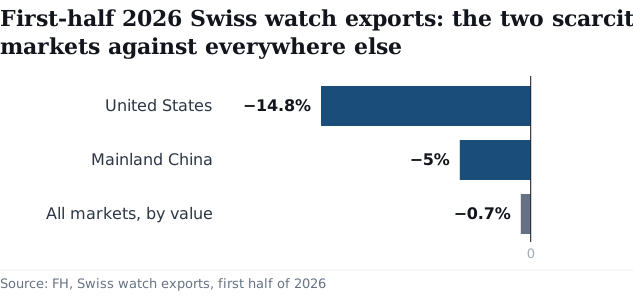
The Federation of the Swiss Watch Industry’s half-year numbers quietly confirm the shift. First-half 2026 exports slipped 0.7% by value to CHF 12.8 billion — but volumes rose 2.3%, with growth overwhelmingly driven by mechanical watches priced under CHF 500, up 23.8%. Read that pairing again: flat money, more watches, and the growth at the cheap end. That is not the export profile of an industry rationing desire. It’s the profile of one shipping what it can actually sell.
Meanwhile the two markets that powered the scarcity era are both retreating: the US down 14.8% in the half (against an admittedly distorted 2025 comparison, when April shipments spiked ~150% ahead of tariff deadlines), and mainland China down 5% — a market that has slid from the industry’s second-largest to its sixth in under two years.
The waiting-list model was built for a world where demand embarrassingly exceeded supply at every price point. That world ended somewhere in 2023. The lists just haven’t all been told yet.
Except — and it’s a big except
Here is what makes this moment genuinely interesting rather than a simple correction story: the steel Daytona is still, in practical terms, unbuyable at retail. Dealers reserve the halo references for clients with multi-year purchase histories, exactly as before. The same holds for a handful of others — certain Patek and AP references chief among them.
So the honest picture is not “the waiting list is dead.” It’s a bifurcation:
- The genuine article: a tiny set of references where demand truly exceeds what the brand will ever make, and where a list — however gamed — reflects reality.
- The imitation: everything else, where the list was a marketing posture borrowed from the genuine article, and where that posture is now collapsing into availability, discreet discounts, and suddenly attentive sales staff.
For a decade the imitation successfully wore the costume of the genuine article. The costume is coming off.
What comes next
Watch three things. First, the retail-to-secondary gap — it’s the one price signal nobody can spin. Where secondary sits below retail, the list is theatre; walk in and negotiate accordingly. Second, certified pre-owned programmes, which let brands participate in secondary pricing they used to pretend was beneath them — a tacit admission that the scarcity story needed a safety net. Third, what brands do with production: the disciplined response to softening demand is to make fewer watches and protect the mystique; the tempting response is to keep volumes and let the discounting start. The FHS volume numbers suggest more of the industry is choosing temptation than will admit it.
The waiting list was never really about watches. It was about borrowing the prestige of five references and renting it out across five hundred. That loan is being called in — and the five references, infuriatingly, remain as unbuyable as ever.