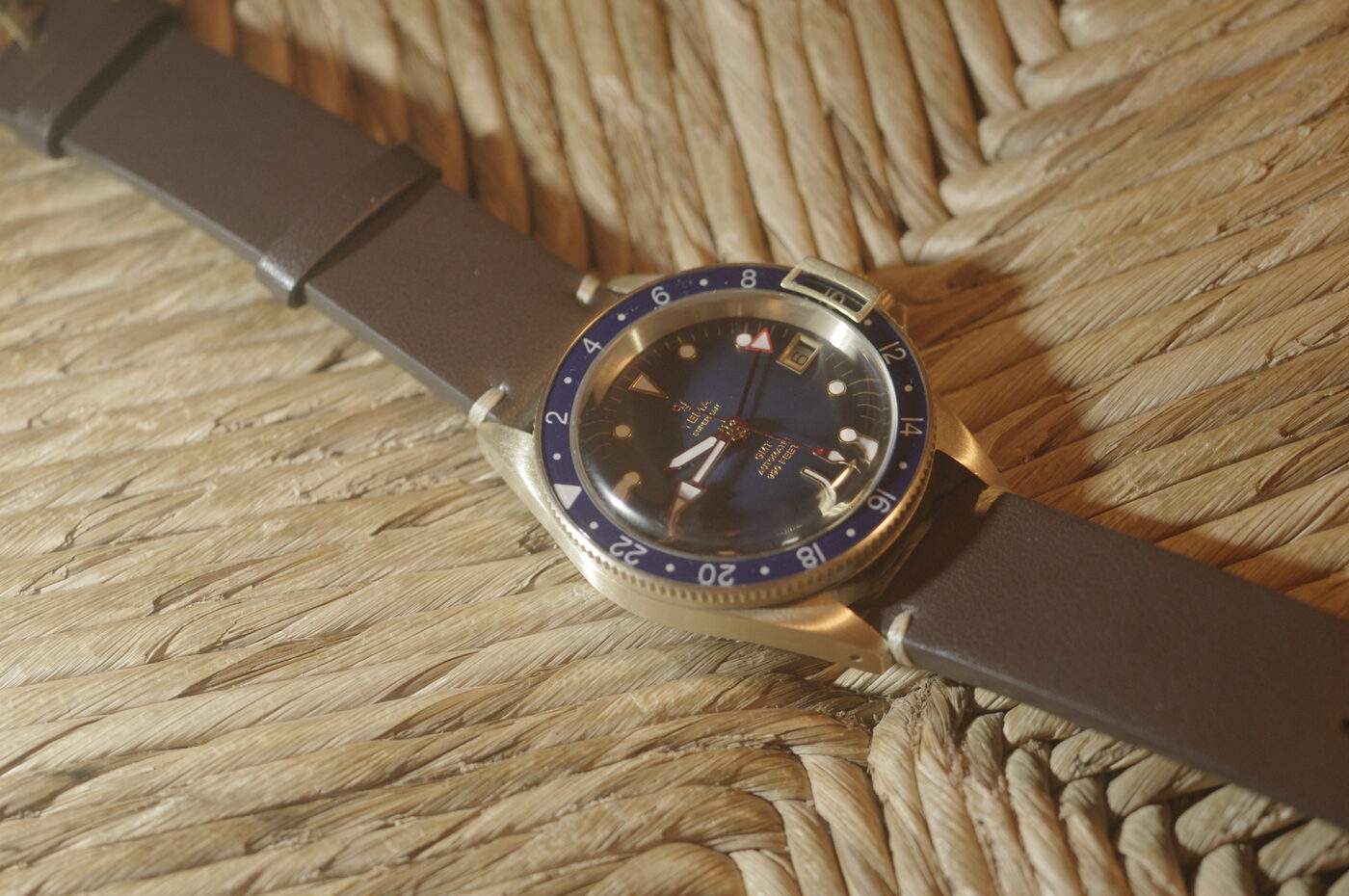
Start with the object, because that is where most people start. The Yema Superman is a French dive watch with a lever at four o’clock that locks the bezel, and it costs a thousand dollars. It is the watch people mean when they say there is such a thing as French watchmaking, and it has been in some form of continuous production since the 1960s — through a quartz collapse that killed most of its neighbours, four changes of ownership, and a stretch its own corporate timeline declines to describe.
The lever is worth a sentence of its own, because it is the one piece of the watch Yema can point to a patent for. A dive bezel turns one way only, so that a knock can shorten your reading of elapsed time but never lengthen it — the failure mode is surfacing early, not late. The lock goes a step further and stops it turning at all until you release it. In 1967, when Yema filed for it, that was close to unheard of at any price; sixty years on it is still the reason a Superman feels like a tool rather than a reference to one.
That is a good story and it is not the interesting one. The interesting thing about Yema is on a page most readers will never open, and it is this: the company publishes exactly which parts of its movements it makes and which it buys.
The disclosure
Yema’s in-house calibre page says that the mainplates and bridges of its Calibre Manufacture Morteau movements are manufactured in-house, that the regulating organs are Swiss, and that every component is made within 72 kilometres of Morteau before assembly in the Morteau workshops.
Read that again with an industry eye. The regulating organ — the balance, the hairspring, the escapement — is the part that is hard to make, the part that decides whether the watch keeps time, and the part that a supplier in the Swiss Jura almost certainly made. It is also the part that every marketing department in watchmaking would rather describe with an adjective than a supplier. Yema names the category, states that it is bought, and gives you a radius.
We have written before that “in-house” has no agreed definition and no legal one, and that the components in watches at every price point come from a small number of specialists whom the marketing does not name. We have also written that the single most important supplier in Swiss watchmaking is owned by a competitor, which is the whole reason the regulating organ is the interesting question and not the boring one.
Against that background, a brand voluntarily drawing the line — this side ours, that side Switzerland’s, everything inside 72 kilometres — is doing something the industry’s largest houses avoid. Not because Yema is more virtuous. Because it is not big enough for vagueness to be an asset. A brand that cannot claim total integration has two options: imply it, or define it. Yema defines it, and the definition turns out to be more persuasive than the implication would have been.
What the movement actually is
The CMM.20, the micro-rotor calibre in the Superman Slim, is specified publicly and precisely: 32.20mm across and 3.70mm thick, 4Hz, a 70-hour power reserve, a Glucydur balance, Incabloc shock protection, 33 jewels, 190 components, and a stated accuracy of -3/+7 seconds a day. Yema calls the parts “Franco-Swiss” without hedging about it.
Those are respectable numbers. -3/+7 is tighter than the -4/+6 chronometer standard at one end and looser at the other, so it is not a chronometer claim and is not dressed up as one. Seventy hours is genuinely useful. A micro-rotor at this price is unusual, because a micro-rotor is harder to make efficient than a full rotor and buys you thinness rather than performance.
What none of it tells you is longevity, and nobody’s specification sheet does. A movement family that first appeared in this generation in 2021 has not yet been through the ten years of servicing that would tell you whether the plates hold tolerance and whether parts are available in 2036. That is not a criticism; it is the clock that has not run yet.
Four owners and a gap
Yema’s own history page gives the sequence plainly, which is again more than most:
| | | |—|—| | 1948–1982 | Henry-Louis Belmont, who founded it after graduating top of his class from the Besançon watchmaking school in 1931 | | 1982–1986 | Matra / Richard Mille | | 1986–2004 | Hattori-Seiko | | 2009–present | Ambre France, in Morteau, run by the third-generation Bôle family |
Look at the gap. Between 2004 and 2009 the timeline says nothing, and the brand that documents a bezel patent from 1967 has no entry for five years of its own recent past. We are not going to speculate about what happened in them; we are going to note that the omission is the only conspicuous silence on an otherwise unusually forthcoming page, and that the years either side of it — the tail of Japanese ownership, the arrival of the current French owner — are the ones that explain how a 1948 name ended up where it is.
The Richard Mille line in the middle is not a typo, and it is the sort of detail that gets repeated for fun without much thought. What it means practically is that Yema passed through the hands of a French industrial group and out the other side, which is the ordinary fate of a mid-market European watch brand in the 1980s, not a secret pedigree.
The question the range asks
Here is where the profile stops being flattering.
The Superman today is not one watch. Yema’s own collection page runs from Superman Classics at $1,004 — reissues of the 1970s model — through Gilt and Bronze at $1,999, Titanium and Dato at $2,090, the Skin Diver at $2,490, the micro-rotor Slim at $2,790, and finishes at a titanium Superman Tourbillon at $13,000, described as combining “haute horlogerie finishing with true tool-watch performance”.
That is a thirteenfold spread under a single model name.
We asked a version of this question about Seiko, which sells from £80 to £8,000 and cannot explain the difference to the people buying. Yema is in a better position to answer, because its calibre names do real work: CMM.10, CMM.20, CMM.30 are distinct movements and the price steps follow them. A buyer who reads the site can work out what the extra money buys.
But a buyer who reads the site is not the general case, and the general case sees “Superman” on a $1,004 watch and “Superman” on a $13,000 one. The name is doing the reassuring at both ends, and the equity that makes the tourbillon plausible was built by the cheap one. Spend the name upward often enough and the thing that made it worth spending — that this is the honest French diver you can actually buy — becomes a story about a brand that also does tourbillons.
The honest counterweights
The heritage is thinner than the retelling. The Superman is dated to 1963 nearly everywhere it is written about. That date is not on Yema’s history page, which does not mention 1963 at all; its Superman entry is 1967, and it is about the bezel-lock patent. The collection page says only “first introduced in the 1960s”. We are not saying 1963 is wrong. We are saying that a company which documents its own past in detail has not put its name to it, and that a date repeated for sixty years by everyone except the brand is exactly the sort of claim this masthead now keeps a ledger for.
“Largest French manufacturer, 500,000 a year” is the other one. It is repeated constantly, it is entirely plausible for a Besançon plant in that era, and we cannot find a filing or a company statement behind it. Both are in the ledger with a bounty on them.
The company is small and the ambition is not. An in-house calibre programme, a tourbillon, a military supply relationship from 2020 and a second generation of movements from 2021 is a great deal of front for a family firm in Morteau. Every one of those is a fixed cost that has to be carried by volume the brand does not obviously have.
What we will be watching
Whether the tourbillon stays an outlier or becomes a direction. Whether the CMM movements are still being serviced, with parts, in ten years — the only test that matters and the one nobody can pass early. And whether the disclosure survives success: the incentive to become vague about the regulating organ grows with every step up the price ladder, and the day that page stops naming what is bought is the day this profile needs rewriting.
Verdict: Established
Not because it is old — plenty of dead names are old. Because it makes its own movements’ plates and bridges, in a building it owns, in a town that has made watches for two centuries, and it says out loud which parts it does not make. In a category built on strategic vagueness, that is the rarest thing on offer, and it is worth more than the 1963 nobody can source.
Buy the Superman for a thousand dollars. That is the watch the reputation is made of, and the rest of the range is a question the brand has not finished answering.