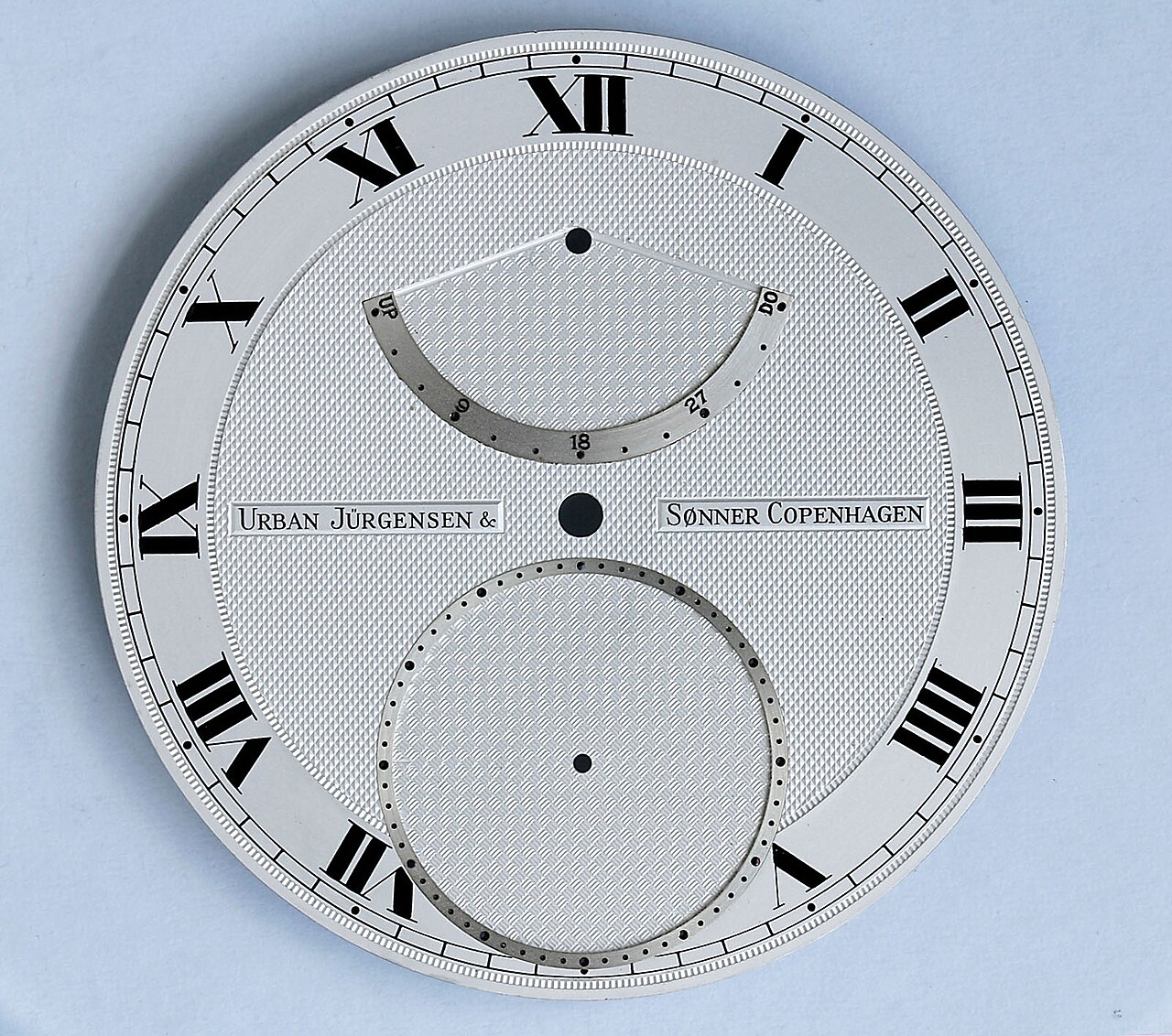
Start with the word, because the word is doing the work.
“In-house” has no definition. Not a legal one, not an industry one, not a threshold anybody has agreed and published. There is no percentage, no register, no certification, and no body that adjudicates a claim. A brand that designs a movement and has it built elsewhere may say it. A brand that assembles a bought movement in its own building may say it. A brand that makes its own bridges and buys everything else may say it, and frequently does.
Compare that with “Swiss made”, which is a legal indication, protected in ordinance, argued over by lawyers and defended by the industry’s own federation as the only true reference it has. Whatever you think of where its thresholds sit, it is a definition. It exists. It can be breached.
“In-house” cannot be breached, because there is nothing to breach. It is a marketing register that borrows the authority of a technical one.
What is actually in a watch
Here is the part that gets lost. A wristwatch is a movement, a dial, a set of hands, a case, a crystal, a crown, a gasket set, a strap or bracelet, and a clasp. The movement is the component the marketing talks about. It is one of nine.
The other eight overwhelmingly come from specialists. Not from disreputable specialists — from very good ones, with a century of practice, serving brands at every price point simultaneously.
You do not have to take that on trust, and you do not have to take it from a leak. Swatch Group publishes the list on its own website, under a heading called Production:
- MOM Le Prélet makes dials. The company’s own page describes “exceptional know-how in the field of dials, acquired over more than a century.”
- Rubattel & Weyermann also makes dials, and describes itself as “a leader in our field and one of the most important players in the watch dial segment.”
- Universo makes hands, including — its page notes — “the high-definition electroforming of watch hands whose geometry is such that traditional swaging is impossible.”
- Manufacture Ruedin makes cases: “watch cases and components in hard metals, ceramics or two-color gold / steel and other external watch parts.”
- Meco Suisse makes crowns, tubes and push buttons, “with tolerances measured in hundredths of a millimeter.”
- Comadur makes the hard parts — “rubies, sapphires, ceramics, cermets and magnets.” Your crystal and your jewels.
- Nivarox-FAR makes hairsprings and escapement components, the descendant of the Waldenburg laboratory where the modern hairspring process was worked out.
- ETA makes movements, which is the one everybody already knows.
That is a complete watch, assembled from one group’s subsidiaries, and the group in question also owns brands from Swatch at the bottom to Breguet at the top. The same portfolio supplies both ends.
The £1,500 watch and the £15,000 watch
The consequence follows without any need for insinuation. If a small number of specialists make the dials for the industry, then watches at wildly different prices share dial suppliers, and sometimes share dials.
This is where the piece could turn into an exposé, and it should not, because the arrangement is not a con. It is the reason the quality is as high as it is.
Making a dial well is a specialised industrial art. Stamping, applying, printing, lacquering, plating, guilloché, enamel — each is its own discipline with its own tooling and its own failure modes. A company doing nothing else for a hundred years, at volume, across dozens of clients, gets better at it than a brand doing it for itself at a fraction of the volume. The specialist’s tooling is amortised across the industry. Its rejects teach it faster than yours teach you.
The same argument holds for hairsprings, where it holds hardest. A hairspring is a few micrograms of alloy whose elasticity has to stay constant across temperature, magnetism and a decade of flexing several times a second. It is the single hardest routine component in the object. Nobody has displaced Nivarox by being annoyed about depending on it, and the brands that did solve it independently — silicon, or genuinely in-house springs — spent years and serious money to arrive somewhere comparable.
Specialisation is not the compromise. Integration is the expensive alternative that occasionally pays off.
So the honest position is this: at most price points, a watch built from bought specialist components is better than the same watch would have been if the brand had insisted on making everything. The marketing has it backwards, and it has it backwards on purpose, because “we buy the best dials in Switzerland” is a harder sentence to sell than “in-house.”
Where the vocabulary came from
The word did not appear because brands woke up proud of their bridges. It appeared because they were made to be.
For most of the last two decades the supply of ETA movements to third parties was restricted, wound down under a competition settlement and finally released in 2020 — the subject of our piece on what happens if the tap reopens. A generation of brands under CHF 3,000 spent that period being pushed off ETA and onto Sellita, Miyota, or a development programme of their own.
That was a supply problem. The marketing department’s job was to make it sound like a philosophy, and it did the job well. Being unable to buy the industry’s default movement became a demonstration of ambition. Necessity was renamed integrity, and the renaming stuck so thoroughly that it outlived the restriction that caused it.
Which is the part worth noticing. ETA sits in the same Production list as the dial makers and the case makers, under the same parent. The company whose withdrawal made “in-house” a virtue is a sibling of the companies still quietly supplying the components nobody advertises.
What integration actually buys
The counter-case deserves a fair hearing, because at the top of the market integration is not theatre.
A brand at genuine scale — the handful that make their own hairsprings, or moved to silicon, or run their own case tooling — buys three real things. It buys the ability to change a design without asking a supplier’s roadmap. It buys immunity from a competitor controlling a critical part. And it buys the capacity to service a reference for decades, because the tooling is in the building rather than in a contract.
Those are worth money. They are worth money at Rolex volumes and Patek prices, where the fixed cost is spread across enough watches and enough decades to make sense.
They are not obviously worth money at four thousand pounds, on a run of six hundred pieces, from a brand eight years old. That is the case where a bought specialist component is almost certainly the better watch, and where the word is doing the most work to suggest otherwise.
What the language costs
Two things, and neither is outrage.
The first is that buyers are paying for a picture of watchmaking that stopped being true around the time the quartz crisis rearranged the industry. A brand implying that a watch is the product of one roof, one workshop and one continuous tradition is selling a nineteenth-century image of a twenty-first-century supply chain. When the buyer eventually learns how it works — and the internet ensures they do — the discovery lands as a betrayal rather than as the reassurance it should be.
The second is subtler. The word “in-house” has drifted from describing a manufacturing fact to signalling a price tier. Once it signals a tier, brands buy the signal rather than the capability: a calibre developed elsewhere to specification, badged as proprietary, at a price that assumes the customer read the word as the fact. The customer is not being lied to in any actionable sense. They are being invited to draw a conclusion the seller has been careful not to state.
The part worth caring about
Strip the marketing and one genuinely important question survives, and it is not about prestige.
Which components a brand controls determines what happens to your watch in fifteen years.
A brand that owns or has secure long-term access to its movement, dial and case tooling can service a discontinued reference. A brand that assembled bought parts under a contract that has since lapsed frequently cannot, and neither can you, and neither can an independent watchmaker, because the part does not exist and the tooling was scrapped. This is the reason to ask about supply chains, and it is almost never the reason the question gets asked.
It is also the question a brand will answer least willingly, because the honest answer is often “we do not know yet.”
So the checkable version, for anyone buying: ask how long parts are guaranteed, in writing, and whether the movement is serviceable by anyone other than the brand. Both answers are verifiable, both are about your watch rather than the brand’s self-image, and neither depends on a word that means nothing.
What we are not claiming
For clarity, because this is a supply-chain piece and supply chains attract confident nonsense.
We are not naming which specific brand buys which specific dial from which specific supplier. Those relationships are commercial, largely unpublished, and where trade reporting has established one it has generally done so for a single reference at a single moment. Anything beyond the corporate ownership set out above — which is published by its owner — would be inference, and inference labelled as fact is the failure mode this publication exists to avoid.
What is on the record is the structure: a small number of specialists, named by their own parent company, supplying components across the price range, under a word that invites buyers to assume otherwise.
The supply chain is not the embarrassment. The vocabulary is.