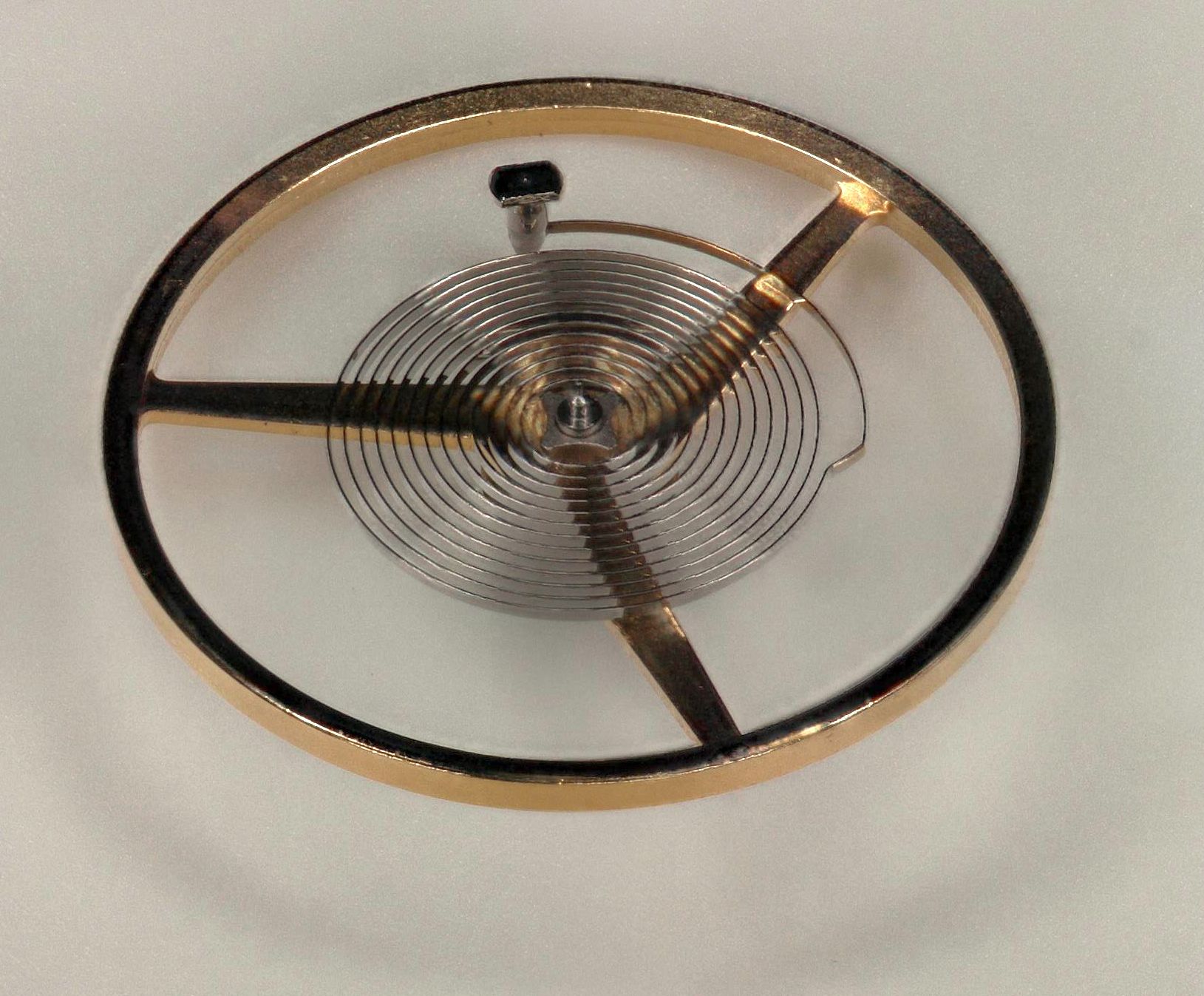
Take the back off a mechanical watch and find the part that is moving fastest. A modern balance oscillates four times a second in most watches, eight times in a high-frequency one. Every one of those swings is powered and constrained by a coil of alloy thinner than a human hair, wound in a spiral, fixed at one end to the balance staff and at the other to a stud on the balance cock.
That is the hairspring. It is the reason the watch keeps time, and it is the hardest routine component in the object to make.
Not the most expensive. Not the most decorated. The hardest.
Why it is hard
Three problems, and they fight each other.
The alloy has to be elastically stable. A hairspring flexes and relaxes roughly 350,000 times a day, every day, for decades. Any metal that work-hardens, creeps or fatigues on that duty cycle changes its rate as it ages, and a watch whose rate drifts as it wears in is a watch that was never regulated in any meaningful sense.
It has to be thermally compensated. Metals get less stiff as they warm. Left uncorrected, a balance and spring run slow in a warm room and fast in a cold one, by an amount that swamps every other error in the movement. The nineteenth century solved it mechanically, with bimetallic balances that changed diameter to cancel the spring’s softening — a beautiful fix that added parts and cost. The twentieth century solved it in the metallurgy instead, by finding alloys whose elasticity barely moves across the temperature range a wrist actually experiences. That transfer of the problem from the balance to the spring is why modern balances are plain rings and modern hairsprings are exotic.
And it has to be shaped to a tolerance that is close to absurd. The coils must not touch each other under any amplitude. The spring must breathe concentrically, so its centre of gravity does not shift as it opens and closes, because a shifting centre of gravity makes the rate depend on the watch’s position. Achieving that means a terminal curve — the outermost coil bent up and over on a defined path — set by hand or by a process that replicates a hand to within microns.
Get any of the three wrong and the watch runs. It just does not keep time, in the sense that matters.
This is what a COSC chronometer certificate is measuring, in the end: the certification tests rate across positions and temperatures over days, and almost every way of failing it traces back to the oscillator.
The company
Swatch Group publishes the history on its own website, and it is worth reading in its own words.
Nivarox-FAR is “the leading Swiss specialist in the production of oscillating and escapement parts,” formed in 1984 from the merger of Nivarox SA and Fabriques d’Assortiments Réunis. The company’s page dates the origin to 1933, “when Dr. Straumann perfected the process of hairspring manufacturing in his Waldenburg laboratory.” FAR was constituted a year earlier, in 1932, out of several component makers around Le Locle.
Four plants, in the Jura. The list of what it makes reads like an inventory of everything in a watch that has to be right:
escapement parts: pallet, escape wheel and impulse-pin, rubies to lift the pallets and ruby impulse-pins, oscillating parts: balance (inertia-block, screws, nut), balance-spring, sprung-balance…
Pallet, escape wheel, balance, balance-spring. That is the entire regulating organ of a mechanical watch, from one supplier, described by its owner as producing components “central to some of the world’s most prestigious mechanical watches.”
The rubies come from a sibling: Comadur makes “rubies, sapphires, ceramics, cermets and magnets” inside the same group. So does ETA, which makes the movements those parts go into.
The structure, stated plainly
Swatch Group owns the leading Swiss maker of the regulating organ. Swatch Group also owns watch brands from the bottom of the market to the top of it.
Which means a very large part of the Swiss mechanical watch industry buys its single most critical component from a company owned by a direct competitor.
How large is where we have to be careful. The figure repeated across the trade for years is that Nivarox supplies somewhere north of 90% of Swiss mechanical hairsprings. We are printing it because a reader who follows this industry has already met it a dozen times and deserves to know what it is worth — which is this: we could not trace it to a primary source. No filing, no regulator’s finding, no company statement. It appears in coverage without attribution, gets repeated, and hardens into a fact by repetition alone.
So treat it as the trade’s working assumption rather than a measured number. What is documented is narrower and still sufficient: Swatch Group calls the company “the leading Swiss specialist” in the category, and the category is the entire regulating organ. You do not need a percentage to see the shape of that.
If anyone can point at where the 90% originates, we will print the correction and name the source.
Nobody did this on purpose. It is the residue of the quartz crisis, when the Swiss component sector consolidated into what became Swatch Group because the alternative was for much of it to disappear entirely. The concentration that looks like leverage today was, at the time, a rescue. That history matters, because it is the difference between a structure to be understood and a conspiracy to be exposed, and this is the former.
It is still a remarkable thing for an industry to be comfortable with.
Why nobody escaped
Sixty years of ambition, a category that prices its watches in five figures, and the dependency persists. The reason is the difficulty described above, and Swatch Group is quite happy to tell you so. From its own 2018 announcement of a new balance spring:
Of all the watch components required to make a [watch], the balance spring is one of the most critical. Its production requires a high level of know-how and expertise.
That is the supplier explaining why it is hard to replace, in a document whose purpose is marketing. It happens to be true.
Two routes out have actually worked, and both are instructive.
Silicon. A spring etched from silicon rather than drawn from alloy is dimensionally near-perfect, immune to magnetism, and needs no thermal compensation from the balance. It also requires semiconductor fabrication, which is not a watchmaking competence, and it took the industry’s largest players and a research institute years to industrialise. Its adopters are the names you would expect. Silicon is a genuine escape and it is expensive to reach.
A better alloy. The other route is to do what Straumann did, again, with modern metallurgy. Which brings the story to its sharpest point.
Nivachron, announced in 2018, is a titanium-based paramagnetic alloy that reduces the residual effect of magnetic fields “by a factor of 10 to 20, depending on the caliber,” and holds its rate well against the temperature swings of ordinary wear. It is a real advance and it addresses the one weakness alloy springs have against silicon.
It was developed by Swatch Group in collaboration with Audemars Piguet.
Read that again. The most credible non-silicon answer to the industry’s dependency on Swatch Group was co-developed with Swatch Group. Even the escape route runs through the building.
What it means if you are small
Here is where the structural point stops being interesting and starts being operational.
A brand selling a few thousand mechanical watches a year has no realistic path to its own oscillator. Silicon needs a fab partnership. An alloy programme needs metallurgists and a decade. Buying from the leading supplier is not a failure of ambition; it is the only available option, and the watches are better for it than they would be if that brand improvised.
The exposure is not about quality. It is about supply, and the industry has already run this experiment once. ETA — a sibling company in the same group — spent most of two decades restricting movement sales to third parties, a restriction wound down under a competition settlement and finally lifted in 2020. We wrote about what happens if that tap reopens. The relevant part here is simpler: the industry has direct, recent experience of what it feels like when a Swatch Group component supplier decides to serve the group first.
Whether the regulating organ could ever be restricted the way movements were is not something we can assert. A dominant supplier operates under competition law precisely because that question exists, and no ruling has tested it for escapement parts. What can be said without any speculation at all is that a brand with no second source for its oscillator has a single point of failure it does not control, and that the last time this pattern played out in this group, it reshaped the market beneath CHF 3,000 for twenty years.
The honest summary
Nivarox-FAR is very good at the hardest thing in the watch. Its dominance is earned rather than engineered, its history is a rescue rather than a land grab, and the components it supplies are a reason Swiss mechanical watches at every price keep time as well as they do.
And a large share of an industry that markets itself on independence, integration and self-sufficiency depends for its most critical part on a company owned by its biggest competitor — a competitor that has, within living memory, prioritised its own brands when supply got tight.
Both of those are true at once. The industry’s habit is to mention the first and not the second.
What is not claimed here
The 90% figure above is reported, not verified, and it is labelled that way in the text where it appears. We print it because it is the number the industry uses and a reader is entitled to know both that it exists and that its origin is untraced. It is not load-bearing here: every conclusion in this piece follows from Swatch Group’s own published description of what Nivarox-FAR is and makes, and would survive the percentage turning out to be 75 or 95.
We claim nothing about what Nivarox-FAR charges, to whom, or on what terms. Component pricing in this sector is private, the comparisons that circulate are unattributed, and the argument does not need them.
Nor do we claim that access to escapement parts has ever been restricted the way movement supply was. No regulator has tested that question for oscillating components, and the piece says so where it raises the parallel.