In our field guide to independent watchmaking, the recurring failure mode was simple: the founder’s hands are the product, and hands don’t scale. Every profile in this series measures an atelier against that trap.
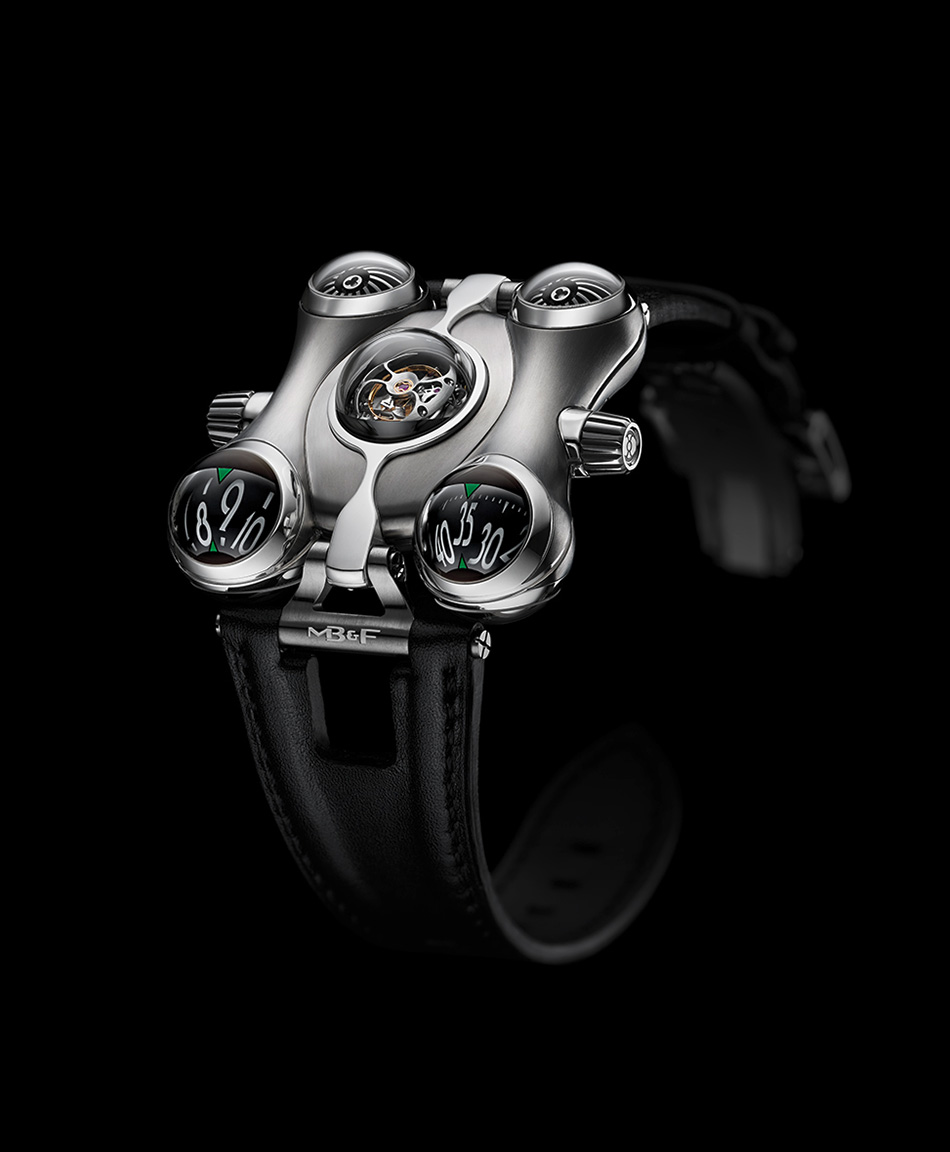
MB&F is the interesting case because Maximilian Büsser saw the trap in 2005 and simply declined to enter it. He is not a watchmaker. He has never pretended to be one. The brand’s own name — Max Büsser & Friends — is a disclosure statement: the product is Büsser’s imagination, executed by a network of named collaborators, engineers and finishers. Where Journe’s dial says Invenit et Fecit, MB&F’s entire structure says conceived it, and knew who should make it.
For twenty years the watch world has filed this under “independent watchmaking” and moved on. It deserves more precise credit than that: MB&F quietly built the only business model in the independent space that doesn’t depend on the biology of one artisan.
The numbers under the machines
MB&F discloses more than most independents, and the disclosed numbers describe a real company rather than a romantic workshop. In 2023: 419 wristwatches and CHF 45.4 million in revenue — an average north of CHF 100,000 a piece. Ownership, post-2024: Büsser at 60%, his longtime production and R&D partner Serge Kriknoff at 15%, and — since August 2024 — Chanel at 25%.
Then there is the part most coverage treats as a footnote and we’d call the strategic masterstroke: M.A.D.Editions, the sub-brand launched in 2021, now producing roughly 3,500 pieces a year at accessible prices. Look at what that actually is: a second production curve, mechanically simpler, that lets the company scale volume without touching the scarcity of the Horological Machines. The hype machine sells out via ballot; the halo stays intact; thousands of younger buyers enter the brand’s orbit a decade before they can afford a machine. Every luxury group in Switzerland understands funnel economics. Almost no independent has dared to build one, because it looks like dilution. MB&F built it and made it feel like generosity.
The Chanel stake, read properly
When Chanel took its MB&F position in 2024, six years after its F.P. Journe stake, the pattern stopped being coincidence and became a strategy: quiet minority positions in the two most valuable brand-builders of the independent era, from a private house with infinite patience and a proven record of stewarding a founder’s identity past the founder.
But note the difference in what Chanel bought at each house. At Journe, the stake exists — by Journe’s own account — because family succession was uncertain: it’s a continuity backstop for a craft. At MB&F, the leadership stayed exactly in place and the succession question is different in kind, because the thing that would need succeeding isn’t a bench skill. It’s taste. A creative directorship can, at least in principle, be handed over — fashion houses do it every decade, and Chanel is the world’s leading practitioner of exactly that handover.
That is the cold-eyed case for MB&F outliving every atelier of its generation: its key-person risk is the replaceable kind. Nobody can inherit Journe’s hands. Someone could, conceivably, inherit Büsser’s chair.
The honest counterweights
The model’s strengths have matching exposures, and the reverence economy rarely prices them:
- Concept risk is fashion risk. Sculptural machines are a taste, and taste cycles. A Galet or a Chronomètre Contemporain will read as classical in 2060; whether a Horological Machine reads as visionary or as early-2000s futurism is genuinely unknowable. The auction market’s tepidness toward much of the category’s secondary output — relative to the classical independents — is a data point, not an insult.
- A network is rentable. MB&F’s execution depends on collaborators and suppliers it doesn’t own. That’s capital-light and brilliant — until a key supplier is bought, booked out, or bid away by a group with deeper pockets. The majors have spent two decades vertically integrating for precisely this reason.
- The funnel cuts both ways. M.A.D.Editions makes MB&F a brand many thousands of people own. That is a different social object from a brand forty people own. So far the ballot scarcity has kept the magic intact; the pressure to grow 3,500 toward 10,000 will be constant, and Chanel’s presence makes the growth argument easier to make in the boardroom, not harder.
Verdict
Established — and, structurally, the most durable business in independent watchmaking: real revenue, disclosed numbers, a scale layer no atelier has, succession risk of the manageable kind, and a shareholder whose entire competence is making founders immortal. The romantics will always rank the hand-made ateliers above it. The field guide ranks survival odds, and on that table, the man who never claimed to be a watchmaker built the strongest watch company of the lot.
Profile two in our independents series. Previously: F.P. Journe and the succession problem. Next: Akrivia, and then Laurent Ferrier.