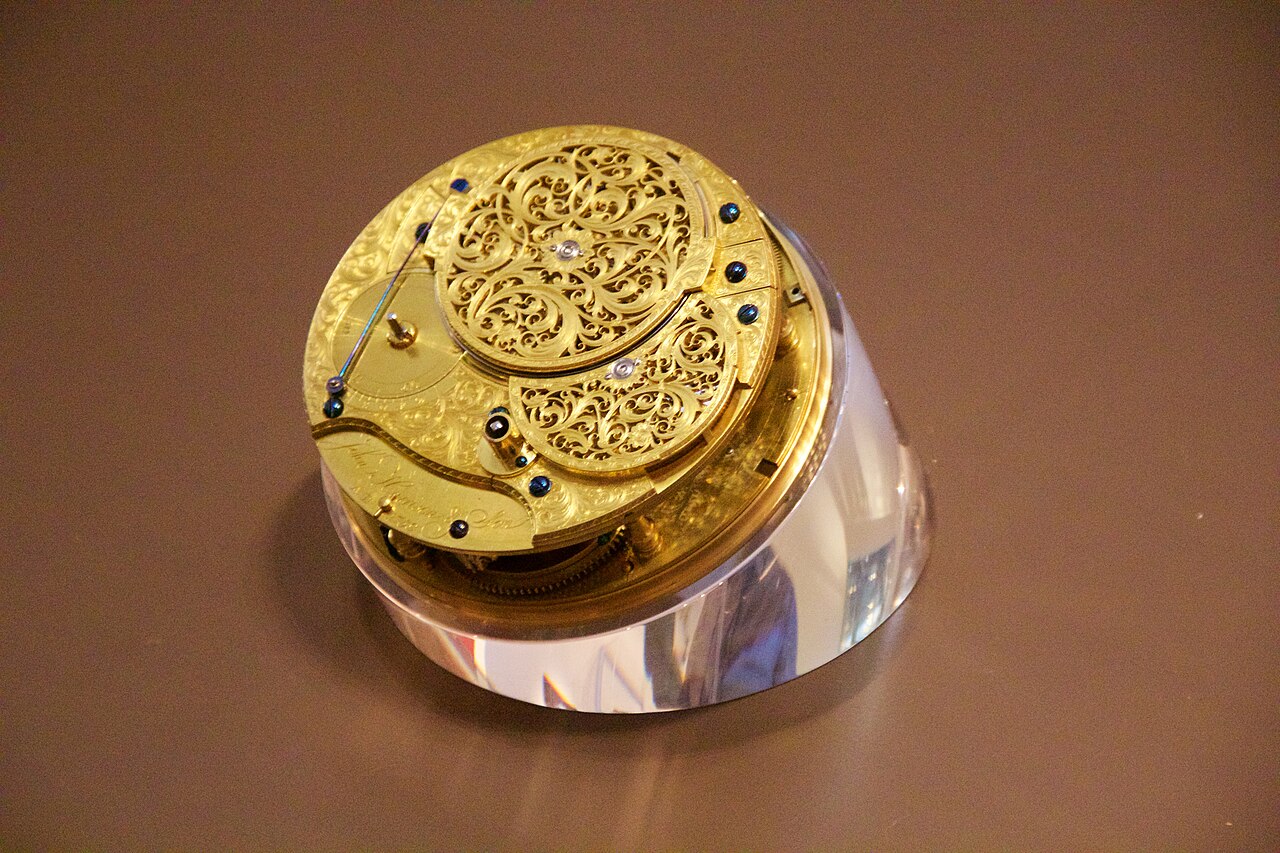
A silver watch on a ship to Jamaica
On 18 November 1761 a fifty-gun ship called the Deptford left Portsmouth for Jamaica with an unusual passenger. William Harrison, son of a Yorkshire carpenter, spent the crossing nursing a large silver watch his father had built, winding it at the same hour each day and keeping it out of the damp. Eighty-one days later the ship made Kingston, and the watch was checked against the known longitude of the port. It was five seconds slow. The Admiralty had spent decades and a fortune trying to solve longitude, and here it was, ticking in a box.
That is where fine watchmaking comes from. Not from jewellery. From dead sailors. Ferdinand Berthoud built marine chronometers for the French navy because the French were losing ships too. Abraham-Louis Breguet patented the tourbillon in 1801 because a pocket watch spent its life standing upright in a waistcoat, and gravity dragged on its rate in ways he could measure. Every founding act of high horology was an answer to a problem somebody had counted the cost of.
Now walk the halls at Watches and Wonders. The lever escapement Thomas Mudge came up with in the 1750s is still ticking in almost every Swiss watch on display. There has been real progress in the last twenty-five years — silicon hairsprings that shrug off magnets, escape wheels that need less oil, power reserves that run through a long weekend — but all of it is a refinement of a 270-year-old idea. Nobody in Geneva is trying to get a ship to Jamaica any more. They are trying to get a Nautilus to a client in Singapore before the grey market does.
And “haute horlogerie”, the phrase that used to mean something, has quietly stopped being a standard and become a font. It appears on watches whose plates come off a five-axis mill, whose perlage is laid down by a machine that never tires, whose bevels are diamond-cut on a line that runs through lunch. None of that is a crime. The tolerances are better for it. The crime is the story sold alongside it, the one with the lone craftsman at a bench in the Jura, when what you are actually paying for is a very good factory. So when a maison asks six figures, put one question to the watch rather than the brochure: what on it could the factory not have done?
Two chairs, vacated
Audemars Piguet, or the house that one watch built
The story is well worn, but it bears repeating because everything AP has done since depends on it. On 10 April 1970, the day before the Basel fair, managing director Georges Golay telephoned Gérald Genta and asked for the sketch of a steel sports watch by the following morning. Genta drew it that night: an octagonal bezel held down by eight exposed screws, an integrated bracelet, a dial engraved with a tiny tapisserie pattern. It launched at Basel on 15 April 1972 at CHF 3,300, which was more than AP was asking for a gold dress watch in the same catalogue and roughly three times the price of a Submariner in Italy, and the trade thought the company had lost its mind. The trade was wrong. The Royal Oak saved the company, and then it slowly became the company.
Fifty-four years later, that is still the problem. AP can do astonishing things when it wants to. The RD#3 of 2022 put a self-winding flying tourbillon into an extra-thin 37mm Royal Oak. The RD#4 the following year squeezed 23 complications and 40 functions into a Code 11.59. The engineers in Le Brassus are not the issue. The issue is what the engineers are asked to do the other fifty weeks of the year, which is find a new dial colour, a new ceramic, a new rapper, a new way to sell the same octagon.
The brand knows this. In 2019 it spent a fortune launching the Code 11.59 as the way out, and the reaction at the fair that January was the closest thing the watch world has to a public execution. Seven years on, the line is still trying to explain itself. A seat at the top of watchmaking should go to a house whose range of ideas is as wide as its price list. Audemars Piguet has one great idea and a genius for reselling it.
Patek Philippe, or the bank that makes watches
For most of its history Patek would not tell you how many watches it made, and the silence did a lot of work. Then, in a rare moment of candour, the company put its own number on the table: a target of around 72,000 pieces for 2025. Sit with that. It is not a boutique. It is a large, superbly run industrial manufacture with a small atelier for grand complications bolted to the side.
There is nothing wrong with being a factory. What matters is who marks your homework. In the spring of 2009 Patek began walking away from the Poinçon de Genève, the independent hallmark it had carried for more than a century, and replaced it with the Patek Philippe Seal. To be fair, the in-house rules are demanding on timekeeping — minus three to plus two seconds a day on calibres of 20mm and over, tighter than COSC, and since 2024 minus one to plus two on anything with a Spiromax silicon spring — and they apply to the finished watch rather than a bare movement. But the exam is now written and marked in the same building. No outside eye checks the anglage any more.
And the mechanical ambition has gone quiet. Patek’s last genuine technical push was its silicon programme in the 2000s: the Spiromax hairspring, the Pulsomax escapement, the Oscillomax package. Since then, the moments that made headlines came from auction rooms rather than the bench. The Grandmaster Chime that went for 31 million francs at Only Watch in November 2019 was a remarkable watch and a more remarkable piece of theatre. The 2024 Cubitus, a square Nautilus for people who could not get a round one, was a commercial product built with precision and with nothing whatsoever to say. Heritage is a wonderful asset. It is not a merit.
The one that stayed
In September 2015 Vacheron Constantin unveiled a pocket watch the size of a saucer. It was called the Reference 57260, it had 57 complications, and three watchmakers had spent eight years building it for a single client. Nine years later the same three did it again, for the American insurer William Berkley this time, and the Berkley Grand Complication landed at 63, with a perpetual Chinese calendar nobody had managed to build before and 2,877 components to do it. Two watches, one customer each, and the better part of two decades of bench time. That is not a marketing plan. It is an obligation being honoured.
That is the difference between Vacheron and the two houses it has just outlived at the top table. Vacheron still acts as though the title carries duties. Most of its collection wears the Poinçon de Genève, the same external hallmark Patek gave up, and the seal’s rules are the rules that matter: interior angles worked by hand, polished screw sinks, finished wheel teeth, and — since the seal was extended to the cased watch — a functional test on the thing you actually wear. Someone outside the company checks the work. In 2026 that is rarer than it should be.
The crafts have not been outsourced to a heritage department either. Grand feu enamel, hand-turned guilloché on rose engines, hand-engraving: at Vacheron these are still jobs people go to on a Monday morning. And the catalogue has more than one idea in it. The Historiques American 1921 with its dial turned forty-five degrees for driving, the Patrimony, the Traditionnelle, and yes, the Overseas, Vacheron’s own integrated steel sports watch, which has ridden the same wave and the same price inflation as everyone else’s.
So Vacheron is not immune to the market. It has simply not been eaten by it. It keeps its chair on merit, and on notice.
The architect from the wrong side of the Wall
On 7 December 1990, thirteen months after the Berlin Wall came down, a 66-year-old man named Walter Lange walked into an office in Glashütte and registered a company that had been dead for forty-two years. His great-grandfather had founded it in 1845. The East German state had nationalised it in 1948. Lange had spent his working life in the West, and now he was back in a small Saxon town with an old name, a partner called Günter Blümlein, and no factory. On 24 October 1994 the new A. Lange & Söhne showed four watches in the Dresden Royal Palace. One of them was the Lange 1. Geneva has not quite recovered.
What Lange did was refuse the shortcuts everyone else had agreed to stop noticing. Every movement is assembled once, adjusted and run, then taken completely apart, finished, cleaned and assembled again. It roughly doubles the labour in every watch and there is no commercial reason for it. The plates and bridges are untreated German silver, an alloy that takes a warm patina with age and takes a fingerprint in an afternoon, so the benches in Glashütte are run with something close to surgical discipline. The balance cock on each movement is engraved freehand, and a good eye can tell which engraver did it.
Then there are the ideas, and this is where Lange pulls away. The Datograph of 1999 gave the world a modern column-wheel flyback chronograph with a minute counter that jumps rather than creeps, and it is still the watch other chronographs are measured against. The Double Split of 2004 was the first chronograph with a double rattrapante; the Triple Split of 2018 took split timing out to the hours. The Zeitwerk of 2009 made a mechanical watch tell the time in jumping digits, and to stop the energy spike of flipping three discs from wrecking the rate, Lange built a constant-force remontoir into it. These are not reissues. They are things that did not exist.
The objections are real and worth saying. Lange lives inside Richemont. Its prices have marched steadily upward. Its sports watch, the Odysseus, is its least convincing product and it knows it. But no other house sets a harder benchmark for how a movement ought to be built, and that, in the end, is what the chair is for.
The physicist from Nagano
In 1978 a Seiko engineer named Yoshikazu Akahane filed a patent for an idea he would spend the rest of his life on. What if you kept the mainspring and the gear train of a mechanical watch, threw away the escapement, and regulated the whole thing against a quartz crystal powered by the movement itself? No battery. No tick. Just a hand that moved the way time does, continuously. It took twenty years and no fewer than six hundred prototypes. Spring Drive was announced in 1998 and went on sale the following year. Akahane died of pneumonia in August 1998, a few months short of seeing it in a shop.
This is why the Grand Seiko chair is not going to F.P. Journe, and the reason is not the one you usually hear. The lazy case against Journe is that he is a romantic, an eighteenth-century mind bound to eighteenth-century escapements. That is simply wrong. Journe put a resonance wristwatch into production at the turn of the century, gave his tourbillon a constant-force remontoir, and built the Chronomètre Optimum around a bi-axial direct-impulse escapement of his own. He is one of the most serious chronometric thinkers alive, and the question hanging over his house is who carries that on, not whether it was ever there.
The difference is what happens next. Journe’s ideas live in small runs of gold watches for people who already own several. Seiko’s research goes into escapements, alloys and manufacturing processes that ship by the tens of thousands, from a group that makes its own springs, its own jewels and its own quartz. That is Harrison’s ethos in its modern dress. Solve the rate error. Then put it on a wrist that has to catch a train.
Spring Drive is the proof. The gear train runs as it would in any mechanical watch, but at the end of it sits a glide wheel that is braked electromagnetically, and the braking is metered by a circuit checking it against a quartz reference. There is no escapement to lock and unlock, no impulse, no tick. What you get is a continuous sweep and a rate Seiko specifies in seconds a month rather than seconds a day. It is not friction-free — the train still needs oil and a service — but the mechanism that generates most of a watch’s error has simply been removed. Switzerland has had a quarter of a century to answer it and has chosen not to try. Seiko, for its part, has never managed to explain any of this to the people buying its cheaper watches, which is a different problem and not the one this chair is judged on.
Then, in 2020, for its sixtieth birthday, Grand Seiko did the other thing. The 9SA5 is a new mechanical escapement, which is a sentence that almost never gets written. Its Dual Impulse design drives the balance directly from the escape wheel in one direction and through the pallet fork in the other, cutting the sliding losses of a conventional lever. The escape wheel and fork are made by MEMS lithography, the balance is free-sprung with an overcoil and beats at 36,000 times an hour, the reserve runs eighty hours, and the rate is held to plus five, minus three. Seiko makes the springs itself, from alloys it developed in-house, because it did not want to buy them from the same supplier as everybody else.
Even the polishing has a job to do. Zaratsu takes its name from the Sallaz lapping machines that came to Japan in the 1960s, and its purpose was written down by Taro Tanaka in 1967 in what he called the Grammar of Design: flat, distortion-free planes and razor-edged facets so that a watch catches whatever light there is and stays readable. It is finishing that earns its keep.
The fair criticism is price. Grand Seiko has pushed its top references into Lange territory, and a brand built on quiet value has to keep proving it deserves the money. On innovation actually delivered, so far, it has.
Three chairs, reassigned
So: Lange for how a movement should be built. Vacheron for the complications and the crafts that the rest of the industry has let slide into a museum. Grand Seiko for the physics, for still believing that the point of a watch is to be right.
There is a twist worth owning up to before someone else points it out. This is not a story about conglomerates corrupting craft. Two of the new three belong to Richemont; the third sits inside a Japanese corporate group. The two houses demoted, Patek and AP, are family-controlled independents. Ownership was never the variable. Allocation was: what a company chooses to spend its capability on once the waiting lists fill up.
Harrison’s watch was five seconds slow after eighty-one days at sea, and men stopped drowning. That is the standard. The houses that deserve the top table are the ones still building as if it were true — not the ones living off what it used to mean.
Verdict: this is a ranking by merit, and merit is a judgement. The facts above are sourced; the chairs are ours.