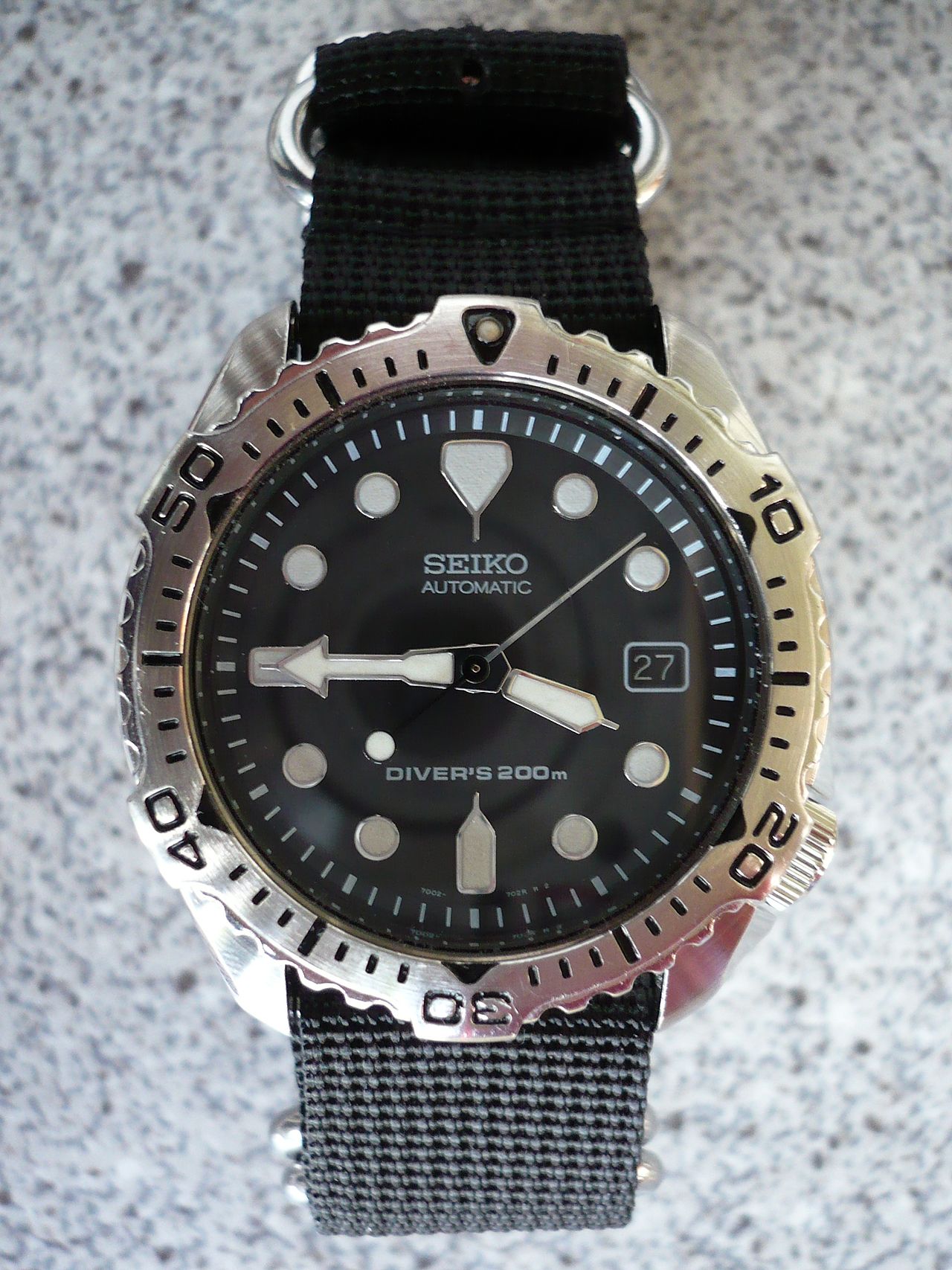
Two facts about Seiko, both true, and the tension between them is the company’s entire strategic problem.
The first: it makes almost everything itself. Movements, hairsprings, dials, cases, and — unusually for anyone — its own quartz oscillators and its own Spring Drive regulator. In an industry where “in-house” is a marketing word covering a bought movement in a bought case, Seiko’s integration is not a claim, it is an inventory. Grand Seiko’s own site mentions Spring Drive twenty-one times on its landing page alone, because it is the one thing in the catalogue nobody else can offer at any price.
The second: it sells watches from about £80 to about £8,000, and cannot tell you why.
Not will not. Cannot. There is no coherent public account of what separates the tiers, because the tiers were not designed. They accumulated.
The integration case, made properly
Take the first fact seriously before criticising the second, because it is the more impressive one and it is routinely undersold.
Almost every Swiss brand at the bottom of the market buys a movement, buys a case, buys a dial, buys hands, and assembles. We wrote about that supply chain and about the single company much of it depends on for hairsprings. Seiko sits outside that structure. It makes its own regulating organ. When the Swiss component sector consolidated after the quartz crisis into a group that now supplies its own competitors, Seiko’s position was simply unaffected, because it was never a customer.
That is why an £80 Seiko keeps time at all. It is not a cheap watch with a cheap movement bought from whoever was cheapest; it is a cheap watch containing a movement designed and built by a company that also builds £8,000 ones, on tooling amortised across tens of millions of units. The integration is the reason the bottom of the range is as good as it is, and the bottom of the range is genuinely remarkable.
Spring Drive is the clearest single proof. A mechanical mainspring driving a glide wheel regulated electronically, with no escapement and no tick — a category of one, developed over decades, that no Swiss house has matched because none of them own both the mechanical and the electronic competence. You cannot buy your way to Spring Drive from a component supplier. You have to be the kind of company that makes quartz movements and hairsprings under the same roof.
The naming problem, traced
Now the second fact.
Seiko’s global site presents, as separate product lines, Presage, Prospex, King Seiko, Astron and Seiko 5. Grand Seiko has its own site and its own collection architecture — Masterpiece, Evolution 9, Heritage, Sport.
Each of those made sense when it was created. Prospex organised the sports and diving references under one banner. Presage did the same for dress watches with an emphasis on dial craft. Seiko 5 was already a sixty-year-old designation with real meaning. Astron marked the GPS solar line, itself descended from the first quartz wristwatch. King Seiko was revived because the name had heritage value and there was a gap between Presage and Grand Seiko.
Individually: reasonable. Collectively: a customer standing in front of them cannot rank them.
Ask the question a buyer actually asks — is a King Seiko better than a Presage? — and there is no published answer. Not a vague answer. None. The lines are not tiers. They are overlapping categories organised by different logics at the same time: Prospex by use case, Presage by dial craft, Seiko 5 by heritage and price, King Seiko by heritage and finishing, Astron by technology. A £400 Prospex diver and a £1,200 Presage are not two rungs on a ladder; they are two different kinds of thing, and nothing on the packaging says so.
The Swiss groups solve this crudely but effectively by using separate brands with separate price bands and separate shops. Seiko put five logics inside one nameplate and then removed the top one.
What Grand Seiko’s separation fixed, and what it broke
Making Grand Seiko a distinct brand with its own boutiques, its own site and its own collections was correct, and it worked. A £6,000 watch cannot share a display case with an £80 one and be taken seriously. The people who spent fifteen years explaining that Grand Seiko was as good as a Swiss house at twice the price were right, and they finally got the retail environment that argument required.
But separation is subtraction. Once the best thing you make has its own showroom, the parent brand is defined by what is left — and what is left is a range whose ceiling has been removed and whose organising principle was already unclear.
King Seiko is where this shows. It exists in the space Grand Seiko vacated: better finished than Presage, priced above it, and explicitly trading on the same 1960s heritage Grand Seiko draws from. It is a good product in an indefensible position, because the honest description of it is “nearly a Grand Seiko,” and no brand can say that out loud about its own watch.
And the separation is not even complete. Grand Seiko’s own site says the word “Seiko” twenty-eight times on its landing page. The parentage is not hidden, because it cannot be — the name contains it. So the brand is simultaneously arguing that it should be judged independently and reminding you, in its own name, that it is not.
What the confusion costs
Here is the measurable part, and it is where the argument becomes uncomfortable rather than academic.
A buyer who cannot rank the range defaults to price. That is fine for the company at the bottom, where price and quality do broadly track. It is expensive at the top, because a customer who cannot see why one watch costs three times another concludes that the more expensive one is overpriced rather than that the cheaper one is a bargain.
That reading is exactly backwards, and it is Seiko’s own fault. The £80 watch is the anomaly. It is astonishingly good for the money precisely because of the integration described above. But if a brand’s cheapest product is its most impressive value proposition, and the brand never explains why the expensive ones are different, then the cheap one becomes the reference point and everything above it looks like margin.
The secondary market is where a reputation for value gets priced, and a range nobody can rank is a range where buyers cannot form confident expectations. We are not going to attach a figure to that here — see the note below — but the mechanism is not controversial: clarity supports residuals, and confusion does not.
What Seiko could say and does not
The fix is not a rebrand. It is a sentence.
Something close to: these lines are organised by what the watch is for, not by how much it costs; here is what each one is for; and here is what changes as the price rises within each. That is one page on a website. Every Swiss group of comparable size publishes a version of it, because the alternative is a shop assistant improvising.
Seiko’s reticence here is cultural rather than accidental, and it is consistent: the company discloses less about itself than a listed Swiss group does, publishes less about its calibres than the enthusiast market would like, and has never gone in for the explanatory marketing that the Swiss industry treats as standard. That reticence is part of why the products are undersold, and it is the one thing in this piece that is entirely within the company’s control.
What is not claimed here
No secondary-market figures. The argument that confusion costs residual value is a mechanism, presented as reasoning rather than as a measurement. Doing it properly means a matched comparison across lines over a defined window, and that is a separate piece with a real dataset behind it. It is not asserted as a finding.
No documented regional catalogue difference. The pitch for this piece raised the regional complication, and it is real in the trade — reference availability genuinely varies by territory. But Seiko’s public catalogues did not let us demonstrate it: the Prospex, Presage and King Seiko pages resolve identically across the global, US, UK and Japanese paths of the company’s own site. So the constraint is noted as trade practice and not evidenced here, because we could not evidence it from the record.
No superlative about integration. Seiko is frequently called the most vertically integrated watchmaker in the world. It may well be. Establishing it would require component-level disclosure from every candidate, which none of them publish, so the piece describes what Seiko demonstrably makes rather than ranking it against companies whose supply chains are private.
And the price range is approximate. “£80 to £8,000” describes the ordinary retail span of the mainstream lines and Grand Seiko. Seiko has made much more expensive watches than that, and Credor exists. The hundred-fold figure is the shape of the problem, not a precise boundary.